

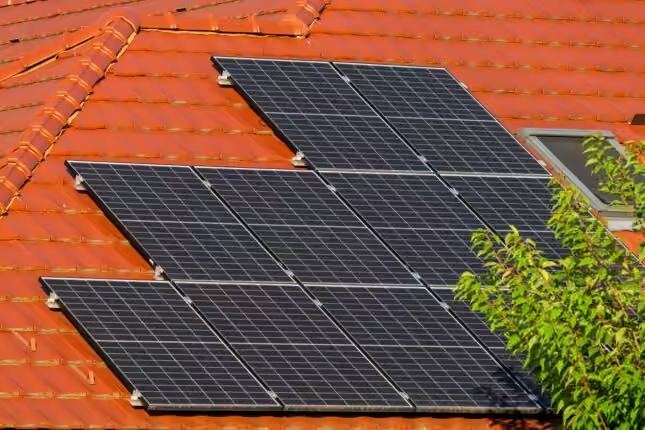
In its judgment of 13.08.2026 (Az. III R 12/25), the Bundesfinanzhof (BFH, Federal Fiscal Court) set out important principles on business splitting and the extended trade tax deduction for real property where roof areas are made available for photovoltaic systems. The court clarified that contractually granted rights to use roof areas may, in principle, establish a functional interdependence between a property-owning company and an operating company. However, this requires the rights of use granted to constitute an essential operating asset for the operating company.
The decisive factor is the economic significance of the areas made available for the operating company as a whole. Merely subordinate significance within an individual business segment is insufficient. The BFH also addressed the effects of a trade tax group on the extended deduction for real property.
Operation of Photovoltaic Systems
The claimant was a residential property company managing its own portfolio and established in the legal form of a corporation. The company had no employees of its own and held all shares in an intermediate holding company (W GmbH). The latter, in turn, was the sole shareholder of another corporation (S GmbH).
S GmbH was an intra-group service company. Its core business predominantly consisted of providing services for the management of residential and commercial properties within the corporate group. It also performed group financing and cash-pool management functions.
In 2008, S GmbH additionally began operating photovoltaic systems. For this purpose, it leased roof areas both from the claimant and from building owners outside the group. It installed and operated photovoltaic systems on the roof areas. It fed the electricity generated into the public power grid in return for payment.
The claimant initially made the roof areas available free of charge. A usage fee was agreed from January 2009 onwards.
Revenue from Photovoltaic Systems of Minor Significance
However, the revenue generated from operating the photovoltaic systems was only of minor significance in relation to S GmbH’s total revenue:
-
In 2008, no revenue had yet been generated from the photovoltaic activities.
-
In 2009, photovoltaic revenue accounted for 0.38% of total revenue.
-
In 2010, the share amounted to 0.71%.
For trade tax purposes, a tax group existed in which the claimant was the controlling company of W GmbH, which in turn was the controlling company of S GmbH.
Extended Deduction for Real Property Claimed
For the years in dispute from 2008 to 2010, the claimant applied for the extended deduction for real property under § 9 Nr. 1 Satz 2 GewStG (German Trade Tax Act).
Following a tax audit, the Finanzamt (German tax office) denied the extended deduction. It took the view that making the roof areas available had created a business split between the claimant and S GmbH. The roof areas constituted essential operating assets for the operation of the photovoltaic systems. As a result, the claimant had itself engaged in an inherently commercial activity, meaning that the requirements for the extended deduction for real property were no longer met.
FG Düsseldorf Largely Upholds the Action
In its judgment of 19.02.2025 (Az. 5 K 814/22 G,F), the Finanzgericht Düsseldorf (Düsseldorf Fiscal Court) largely upheld the action. It found that there was no functional interdependence because making the roof areas available was only of subordinate significance to S GmbH’s business as a whole.
The Finanzamt appealed this decision on points of law to the BFH.
BFH Judgment
The BFH dismissed the Finanzamt’s appeal on points of law in respect of the 2008 year in dispute. For the 2009 and 2010 years in dispute, however, it partially set aside the Finanzgericht’s judgment and remitted the case to the Finanzgericht Düsseldorf for a new hearing and decision.
On the central legal issue, the BFH upheld the Finanzgericht’s view: In the case at hand, making the roof areas available did not create a business split because there was no functional interdependence.
In particular, the BFH clarified that contractually granted rights to use roof areas for the operation of photovoltaic systems may, in principle, establish a functional interdependence. However, this requires those rights of use to constitute an essential operating asset for the operating company.
Subordinate Business Segment
No such essential significance existed in the case at hand. The photovoltaic activities merely represented a subordinate business segment of S GmbH. The corresponding revenue accounted for less than 1% of total revenue. Nor were the photovoltaic activities of essential significance to S GmbH’s other business segments.
Accordingly, the absence of functional interdependence precluded a finding of a business split.
However, this did not conclusively establish whether the claimant was entitled to the extended deduction for real property in full for 2009 and 2010. In this respect, the Finanzgericht still had to examine the effects of the trade tax group and the intra-group provision of the roof areas on the deduction.
Functional Interdependence Through Contractual Rights of Use
According to the BFH’s established case law, a business split requires both functional and personal interdependence between the property-owning company and the operating company. Functional interdependence exists where the property-owning company provides the operating company with at least one essential operating asset for its use.
The BFH first clarified that this does not necessarily require an entire plot of land or building to be made available. Purely contractual rights of use, and thus rights arising under the law of obligations, may also establish functional interdependence.
The contractually granted rights to use the roof areas for the operation of the photovoltaic systems could therefore, in principle, form the basis of functional interdependence.
The Operating Company’s Perspective Is Decisive
The decisive issue in the case at hand, however, was whether the roof areas made available constituted an essential operating asset for S GmbH. According to the BFH, this must be assessed solely from the perspective of the operating company. The relevant consideration is therefore the economic and functional significance of the asset made available to the operating company as a whole.
The assessment must not be confined to an individual business segment. Instead, an overall assessment of all circumstances is required.
An asset must be of considerable importance to the business as a whole. It is insufficient for it to be of essential significance merely to an individual business segment if that business segment plays only a subordinate role in relation to the company’s overall business activities.
No Essential Operating Asset Where Photovoltaic Activities Are Subordinate
In the specific case, S GmbH primarily operated as an intra-group service company. Its focus was on managing residential and commercial properties and on group financing.
By contrast, the operation of the photovoltaic systems merely constituted an additional business segment. The BFH placed particular emphasis on the small share of revenue attributable to the photovoltaic activities. This amounted to 0.38% in 2009 and 0.71% in 2010.
Moreover, the photovoltaic activities were of no essential significance either to S GmbH’s core business or to its other business segments. The property management business could have continued without restriction even if the photovoltaic systems had not been operated.
Even the photovoltaic activities could have continued on a smaller scale without the roof areas made available by the claimant, as S GmbH had also leased roof areas from owners outside the group.
Accordingly, when viewed as a whole, the roof areas made available were only of subordinate significance.
No Automatic Application of the Branch Premises Case Law
The BFH also considered the case law concerning branch premises. According to this case law, individual properties or business premises may constitute essential operating assets even if they account for only a small proportion of the total floor space used for business purposes.
However, the BFH clarified that it does not follow that every asset made available which performs an operational function within an individual business segment automatically establishes functional interdependence.
Even when the branch premises case law is taken into account, an overall assessment of all circumstances is required. The decisive question remains whether the asset made available has functional significance for the operating company as a whole that is more than merely subordinate.
This requirement was not met in the case at hand.
Group Interests Irrelevant to Essential Significance
The BFH further clarified that the assessment of whether an asset constitutes an essential operating asset must be based exclusively on the perspective of the operating company.
The fact that electricity generation from photovoltaic systems may have been of particular interest to the group as a whole or to the property-owning company did not alter this conclusion.
In particular, any potential significance of the photovoltaic activities to the group’s sustainability strategy could not simply be attributed to S GmbH. The decisive factor was instead the economic significance that the photovoltaic activities had for S GmbH itself.
Effects of the Trade Tax Group
In addition to the issue of business splitting, the BFH addressed the effects of the trade tax group on the extended deduction for real property.
According to established case law, add-back and deduction provisions within a tax group are generally applicable only where their effects offset each other.
If only individual assets are made available for use within the tax group and the requirements for the extended deduction for real property are otherwise met, an appropriate adjustment must be made to prevent the controlling company from receiving an unjustified tax benefit.
The Finanzgericht had not made sufficient findings in this regard. In particular, it had not been established whether the income from making the roof areas available for consideration was included in the deduction amounts granted and whether the corresponding expenses had been taken into account for trade tax purposes at the controlled company level.
The BFH therefore remitted the case to the Finanzgericht in respect of the 2009 and 2010 years in dispute.
According to the full text of the judgment, the BFH based the remittal on § 126 Abs. 3 Satz 1 Nr. 2 FGO (German Fiscal Court Code). It transferred the decision on the costs of the proceedings to the Finanzgericht.
According to the judgment, a complete denial of the extended deduction is not possible because the claimant had not leased all properties to controlled companies. The only possible issue is that the rents for the roof areas were incorrectly taken into account. The Finanzgericht must therefore determine whether the rents for the roof areas were incorrectly taken into account. If so, according to the fifth headnote of the judgment, this must be offset by an adjustment within the tax group.
Practical Significance
The judgment clarifies the requirements for functional interdependence where roof areas are made available for photovoltaic systems.
Of particular practical relevance is the fact that granting contractual rights to use roof areas may, in principle, establish functional interdependence. The decisive issue, however, is whether those rights of use constitute an essential operating asset for the operating company.
This requires an overall assessment of all circumstances. In particular, the economic significance of the photovoltaic activities, their share of revenue and their functional significance to the operating company’s other business segments must be taken into account.
At the same time, the BFH makes clear that subordinate significance within the business as a whole may weigh against classification as an essential operating asset. The revenue shares of less than 1% established in the case at hand were a significant indicator in this respect. However, the BFH did not establish a generally applicable revenue threshold of 1%.
Companies should also consider the trade tax consequences of intra-group arrangements under which assets are made available for use. Even if no business split exists, adjustments within a trade tax group may affect the extent of the extended deduction for real property.
The judgment therefore provides important clarity for property companies that make roof areas available to affiliated companies for the operation of photovoltaic systems. At the same time, it demonstrates that any assessment of the extended deduction for real property must always take account of the specific operational circumstances and the effects of an existing tax group.
MTR Legal Rechtsanwälte advises companies, investors and high-net-worth individuals on tax law matters with a business law dimension. Further information is available under Tax Law Advice.