

Establish a gGmbH – Non-Profit Status, Articles of Association & Tax Law for Bielefeld
Establish a gGmbH – Non-Profit Status, Articles of Association & Tax Law for Bielefeld

Establishing a gGmbH in Bielefeld: Legally Secure Setup
Entrepreneurs and clients in Bielefeld trust MTR Legal
In Bielefeld, the economic hub of East Westphalia-Lippe, numerous entrepreneurs are active in the food and machinery industries. For those in Bielefeld looking to establish a non-profit GmbH (gGmbH), compliance with the non-profit requirements is crucial. These requirements not only involve drafting the articles of association but also navigating the tax framework. For family business owners who wish to take on social responsibility, the gGmbH offers a structured way to engage in social, cultural, or educational activities. Legal security and meeting the requirements of the articles of association present significant challenges.
MTR Legal is your competent partner in Bielefeld, providing comprehensive support in establishing a gGmbH. With our extensive client experience and interdisciplinary setup, our team can address the specific needs of entrepreneurs in Bielefeld. The firm offers tailored solutions to efficiently overcome legal and tax hurdles. Trust in our experience to realize your non-profit project legally and successfully. Consult with our team in Bielefeld to plan and implement your gGmbH establishment.
- Herforder Straße 69, 33602 Bielefeld
- +49 521 99987990
- bielefeld@mtrlegal.com
5000+
Mandate
Team
Experienced Attorneys
Global
Operating Internationally
8
Offices
Competence that Convinces.
Leverage our Expertise für Bielefeld and book a consultation to address your concerns professionally.
MTR Legal – Your Attorneys for gGmbH Establishment in Bielefeld
From Analysis to Outcome — MTR Legal in Bielefeld
- gGmbH Establishment: What Clients Need to Know
- gGmbH Establishment in Bielefeld: Legal Foundations
- Who Should Consider a gGmbH
- MTR Legal's Approach to gGmbH Establishment Mandates
- Common Mistakes in gGmbH Establishment: What Clients Should Avoid
- Process and Timeline: Step-by-Step gGmbH Establishment
- Frequently Asked Questions about gGmbH Establishment
- Ongoing Management of a gGmbH: Non-Profit Reports and Documentation Obligations
gGmbH Establishment: What Clients Need to Know
Key Aspects of gGmbH Establishment at a Glance
The establishment of a gGmbH is particularly relevant for social entrepreneurs and NGO founders in Bielefeld, as it offers the opportunity to combine entrepreneurial activities with non-profit goals. In a city like Bielefeld, recognized as the economic center of East Westphalia-Lippe, many founders benefit from the strong presence of medium-sized businesses that often wish to assume social responsibility. The gGmbH allows for tax advantages while making a positive societal impact.
To ensure the non-profit status of a gGmbH, founders must meet specific legal requirements. The articles of association must contain clearly defined non-profit purposes that align with the provisions of the Fiscal Code, particularly § 52 AO. These regulations concern the use of funds and the altruistic nature of the enterprise. Additionally, tax hurdles must be considered, as only non-profit purposes are tax-advantaged. An incorrect charter can lead to the revocation of non-profit status, resulting in significant tax consequences.
For clients, this means that careful legal review and professional advice are essential to meet all requirements and secure the non-profit status of the gGmbH. The MTR Legal team assists in drafting legally secure articles of association and considering all tax aspects. This allows you to focus on building and developing your non-profit projects while we handle the legal details.
gGmbH Establishment in Bielefeld: Legal Foundations
Direct Contacts, Structured Mandates, Clear Communication
The establishment of a non-profit GmbH is a complex endeavor that goes far beyond the usual challenges of starting a business. For social entrepreneurs and NGO founders in Bielefeld, it is particularly important to meet the non-profit requirements while also observing the specific charter requirements. These are crucial to benefit from tax advantages and achieve the desired impact in social, cultural, or educational fields. In Bielefeld, a city with a strong middle class and a thriving social sector, it is vital for founders to have a reliable partner guiding them through this process.
The MTR Legal team in Bielefeld offers structured and personalized advice to lay solid legal foundations for your gGmbH establishment. Precise drafting of the articles of association and compliance with the requirements of § 52 AO are essential to secure non-profit status and overcome tax hurdles. Our approach is not only to minimize legal risks but also to proactively develop solutions that align with your social commitment. Clients appreciate our clear communication and ability to make complex legal contexts understandable.
For you as a founder, this means you can focus on your core business and social goals while we handle the legal details. Trust in the experience and legal acumen of MTR Legal to successfully start and manage your non-profit project in Bielefeld. Our team is with you every step of the way to ensure that your gGmbH is not only legally sound but also sustainably successful.
Create Clarity – Now!
For legal clarity and strategic foresight – our team in Bielefeld is ready to support you. Don’t hesitate to contact us.
Your Team
Competent. Assertive. Successful.
Our team in Bielefeld is at your side in establishing a non-profit GmbH. We place great emphasis on personal and structured advice, always conducted at eye level. Our clients can rely on us to develop individual solutions tailored precisely to their needs. In Bielefeld, we are well-connected and understand the regional specifics that may be relevant to establishing a gGmbH.
We focus on the legal requirements of non-profit status, drafting an appropriate charter, and overcoming tax hurdles. At MTR Legal, you benefit from our extensive know-how in these areas. Our team accompanies you from the initial idea to the final implementation of your gGmbH, ensuring that all legal requirements are met. Trust in our experience and let us realize your non-profit projects together. Contact us to bring your plans to fruition.
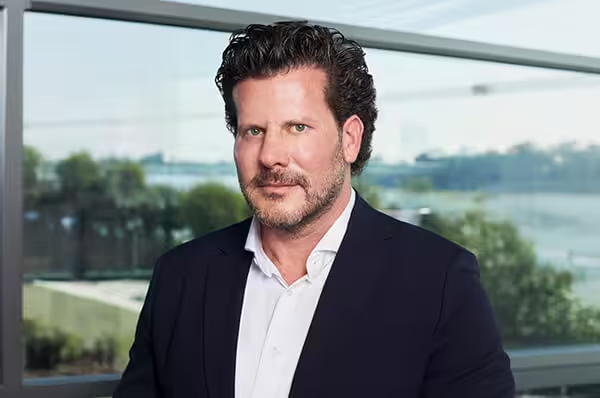
Michael Rainer
Rechtsanwalt, Founder & CEO
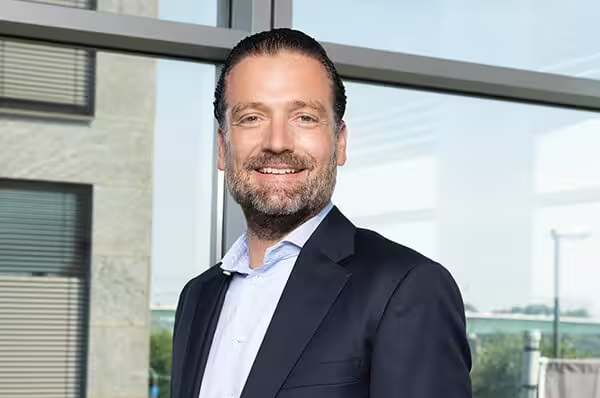
Marc Klaas
Rechtsanwalt, Partner

Michael Below
Rechtsanwalt, LL.M., Salary Partner




Berlin
Cologne
Hamburg
Düsseldorf
Frankfurt
Munich
Stuttgart
Leipzig
Local. Regional. International.
Who Should Consider a gGmbH
Typical Applications and Clients at a Glance
Social Enterprises and Social Entrepreneurs
Social enterprises and social entrepreneurs often face the challenge of aligning their social goals with a viable legal structure. Establishing a gGmbH is particularly suitable for those seeking societal change while engaging in entrepreneurial activities. A gGmbH allows for reinvesting profits while maintaining non-profit status. This is especially advantageous for social entrepreneurs in Bielefeld who wish to develop innovative solutions for social issues in the region and rely on a stable legal foundation.
Educational Institutions and Language Schools
Educational institutions and language schools aiming to implement non-profit educational offerings find the gGmbH to be a suitable organizational form. It allows for tax-advantaged operation of educational projects while ensuring high-quality standards. The charter requirements of a gGmbH help define educational goals clearly and meet the necessary non-profit prerequisites. This enables educational institutions to use resources more efficiently and better reach their target groups, which is particularly beneficial for language schools looking to implement new educational initiatives in Bielefeld.
Cultural Projects and Art Initiatives
Cultural projects and art initiatives benefit from establishing a gGmbH, as this structure offers an ideal balance between artistic freedom and legal security. A gGmbH enables sustainable financing of cultural projects while utilizing tax advantages. Artistic initiatives can plan their projects long-term without losing non-profit status. This is particularly relevant for cultural projects in Bielefeld that rely on a stable legal basis to promote and support local art and cultural scenes.
NGOs with Commercial Activities
For NGOs pursuing commercial activities alongside their non-profit goals, a gGmbH provides a suitable structure. It allows for integrating commercial activities within the non-profit framework without losing tax benefits. The charter requirements and non-profit prerequisites are crucial to maintaining the balance between economic activities and non-profit goals. NGOs in Bielefeld pursuing innovative projects with an economic approach can maximize their impact while fulfilling legal requirements.
MTR Legal's Approach to gGmbH Establishment Mandates
How MTR Legal Structures and Achieves gGmbH Establishment Mandates
Establishing a non-profit GmbH (gGmbH) is a significant step for social entrepreneurs and NGO founders who want to develop their projects on a solid legal basis. Especially in an economically driven environment like Bielefeld, where the middle class thrives, non-profit initiatives can hope for support and collaborations. A gGmbH offers the opportunity to efficiently organize and secure social, cultural, or educational projects in the long term. However, the specific requirements for non-profit status, such as compliance with charter requirements and tax regulations, are crucial for success and recognition of non-profit status.
In the course of establishing a gGmbH, MTR Legal analyzes the client's individual needs in an initial consultation and develops a tailored strategy. A central point is drafting the articles of association, which must meet the requirements of § 52 AO to gain tax recognition of non-profit status. This includes defining the non-profit purpose and the obligation to use funds according to the charter. Tax hurdles are circumvented through precise planning to ensure the gGmbH's long-term success. The establishment is implemented in clearly defined steps and can usually be completed within a few months, depending on the complexity of the projects and the response time of the authorities.
For the client, collaboration with MTR Legal means they can focus on the substantive development of their non-profit projects while the legal and tax aspects are professionally managed. The comprehensive support during the establishment phase paves the way for sustainable and successful non-profit activities. MTR Legal ensures that all legal requirements are met and accompanies the client until the successful registration of the gGmbH.
Need Legal Assistance?
MTR Legal Bielefeld offers professional legal advice. Let’s find the best solution together.
Common Mistakes in gGmbH Establishment: What Clients Should Avoid
What Clients Often Overlook Without Legal Guidance
Establishing a non-profit GmbH (gGmbH) is of great importance for many social entrepreneurs and NGO founders, especially in economically active regions like Bielefeld. In this economic center of East Westphalia-Lippe, many initiatives aim to promote social, cultural, or educational projects. However, there are numerous legal requirements in establishing a gGmbH that are often not fully understood without sound advice. Failing to meet all non-profit requirements can risk not obtaining or losing non-profit status, leading to extensive tax and financial consequences.
A central element in establishing a gGmbH is the articles of association. This must be precisely formulated and fulfill all requirements for non-profit status according to § 52 AO. Founders often underestimate the importance of a clear purpose definition or the necessity to regulate the use of funds in detail. Failures in these areas can lead to the tax office not recognizing non-profit status. Additionally, founders must be aware of tax hurdles, as the gGmbH receives tax benefits only if all legal requirements are strictly adhered to. Without professional advice, founders risk significant tax disadvantages due to formal errors.
For the client, this means that legal advice is indispensable to avoid pitfalls and successfully establish a gGmbH. The MTR Legal team provides comprehensive support in this process to meet the specific requirements for non-profit status and draft a legally secure charter. This allows the client to focus on their core tasks and successfully implement the social, cultural, or educational goals of their gGmbH.
Process and Timeline: Step-by-Step gGmbH Establishment
Phases, Deadlines, and Documents — Structured Overview
The establishment of a gGmbH begins with drafting the articles of association, clearly defining the non-profit purpose. This is followed by notarization. The notary submits the establishment application to the commercial register. Registration usually takes two to six weeks. Simultaneously, registration with the tax office is necessary to have the non-profit status recognized. Only after registration in the commercial register and recognition by the tax office can the gGmbH commence operations. Specific deadlines must be met at each stage to avoid delays.
During the establishment phase, essential documents are required: In addition to the articles of association and shareholder agreement, proof of the capital contribution is needed. The non-profit recognition by the tax office is based on § 52 of the Fiscal Code (AO), which regulates the tax benefits of non-profit status. Correct and complete application submission is crucial to obtaining non-profit status without objections. Errors in the application can lead to significant delays and impact the start of the gGmbH's activities.
For clients in Bielefeld, it is advisable to contact our team at MTR Legal early to ensure a smooth establishment process. Our attorneys guide you through every step, from drafting the articles of association to non-profit recognition, ensuring all legal requirements are met. This allows you to focus on the substantive planning of your non-profit projects.
Have Questions?
Our team in Bielefeld of experienced attorneys is ready to address your legal concerns. Book your callback now!
Frequently Asked Questions about gGmbH Establishment
Concise Answers to Common gGmbH Establishment Questions
What are the requirements for a gGmbH to be recognized as non-profit?
For a gGmbH to be recognized as non-profit, its purposes and activities must comply with the requirements of the Fiscal Code. This means the gGmbH must exclusively and directly pursue charitable, benevolent, or ecclesiastical purposes. The articles of association must be precisely formulated and clearly define the non-profit goals. Additionally, any profits generated must be used solely for the non-profit purpose. These requirements are essential to receive tax benefits.
When is a gGmbH the appropriate legal form for my non-profit project?
A gGmbH is the appropriate legal form when you want to implement a non-profit project with clear structure and limited liability. This legal form is particularly suitable if you plan to engage in economic activities to fund your non-profit goals. It offers the advantage of limiting liability to the company's assets. Additionally, a gGmbH is well-suited to build trust with sponsors and donors, as it is perceived as a legally regulated corporate form.
What tax advantages does a gGmbH offer?
A gGmbH can benefit from various tax advantages if recognized as non-profit. These include exemptions from corporate income tax and trade tax. Revenues serving the non-profit purpose can also be exempt from VAT. However, these tax benefits are contingent upon the gGmbH meeting the strict requirements of the Fiscal Code. Proper bookkeeping and regular reviews of non-profit status by the tax office are therefore essential.
What is the process for establishing a gGmbH?
The process of establishing a gGmbH begins with drafting a partnership agreement that clearly defines the non-profit purposes. This is followed by notarization of the establishment. The gGmbH must then be registered in the commercial register. Simultaneously, recognition as non-profit must be applied for at the tax office. Once these steps are completed, the gGmbH can commence operations. Careful planning and legal advice are recommended throughout the process to meet all legal and tax requirements.
Ongoing Management of a gGmbH: Non-Profit Reports and Documentation Obligations
Key Aspects of Ongoing gGmbH Management at a Glance
The ongoing management of a gGmbH is crucial for social entrepreneurs and NGO founders, particularly in a strong economic environment like Bielefeld. Ensuring non-profit status requires regular reporting and adherence to legal requirements. A key aspect is the preparation of a non-profit report documenting the fulfillment of the statutory purposes. This report is not only a legal obligation but also a tool to ensure transparency and credibility of the gGmbH to sponsors and regulatory authorities. For founders in Bielefeld, operating in an environment with a strong middle class, efficient management of a gGmbH is a key to success.
The legal requirements for the non-profit report are complex. According to the Fiscal Code, this report must be detailed and demonstrate that the use of funds is exclusively for the non-profit purposes set out in the articles of association. Non-compliance can lead to the revocation of non-profit status, resulting in significant tax consequences. Another important point is the documentation obligation to the tax office, derived from § 63 AO. These documentation obligations require the gGmbH to comprehensively document and, if necessary, prove the use of funds. Misunderstandings or errors in this area can lead to a comprehensive tax audit, significantly impacting the gGmbH's operational work.
For our clients, this means that careful planning and continuous monitoring of legal obligations are essential. The MTR Legal team provides comprehensive support, not only helping with the preparation of non-profit reports but also ensuring that all legal requirements are met. This allows our clients to focus on their social or cultural projects while we optimally structure and monitor the legal framework.