

Anti-Money Laundering Compliance – AML & Obligations for Regensburg
Legal Support for UWG Violations

Money Laundering Prevention in Regensburg: Securely Fulfill AML Obligations
Regensburg entrepreneurs and clients trust MTR Legal
In Regensburg, a significant industrial hub with a strong presence of companies like BMW and Infineon, adhering to anti-money laundering compliance is crucial. For local automotive suppliers and electronics companies, implementing the regulations of the Anti-Money Laundering Act (AML) poses a significant challenge. These businesses must not only take the obligation to report suspicious activities seriously but also implement effective KYC processes to avoid penalties. Entrepreneurs in Regensburg need to ensure that their compliance processes meet legal requirements to guarantee smooth operations and growth.
MTR Legal in Regensburg offers you solid support in implementing your anti-money laundering compliance. With extensive client experience and an interdisciplinary setup, the firm is capable of developing tailored solutions for the specific needs of the Regensburg economy. Our experience allows us to design complex legal requirements in a practical manner. Rely on our team in Regensburg to secure the future of your business. Discuss your compliance needs with our team in Regensburg.
- Johanna-Kinkel-Straße 1+2, 93049 Regensburg
- +49 941 69840990
- regensburg@mtrlegal.com
5000+
Mandate
Team
Experienced Lawyers
Global
Internationally Active
8
Offices
Competence that convinces.
Utilize our expertise für Regensburg and book a consultation to professionally address your concerns.
MTR Legal in Regensburg: AML Compliance / Money Laundering Prevention Securely Structured
From Analysis to Outcome — MTR Legal in Regensburg
- AML Compliance: Who is Obligated to Prevent Money Laundering
- Legal Requirements of the Anti-Money Laundering Act
- AML Compliance / Money Laundering Prevention in Regensburg: Legal Foundations
- How MTR Legal Builds Your AML Compliance
- Common Oversights in Money Laundering Prevention
- Step by Step to a AML-Compliant Organization
- Frequently Asked Questions about Money Laundering Prevention
- Structure and Duties of the Money Laundering Officer
- Sanctions for AML Violations
- Interfaces between Tax Law and AML
- Due Diligence in Customer Relationships
- International Money Laundering Standards and FATF
- AML Checklist for Your Company
International Representation
As a member of the international network of lawyers IR Global, we are your contact for cross-border matters and represent you in an international context.
AML Compliance: Who is Obligated to Prevent Money Laundering
All Essential Information on AML Compliance / Money Laundering Prevention Explained
For companies in Regensburg, especially in the highly regulated financial services sector, adhering to AML Compliance is crucial. The Anti-Money Laundering Act (AML) mandates that certain professions such as lawyers, notaries, and real estate agents strictly comply with money laundering prevention regulations. This is not only a legal requirement but also protects companies from significant fines and reputational damage. In a city like Regensburg, characterized by both industrial and tourist activities, such compliance measures play a central role in sustainable business success.
The core mechanisms of AML compliance include implementing Know-Your-Customer (KYC) processes and submitting suspicious activity reports when potential money laundering is detected. According to § 2 AML, companies are required to verify their customers' identities and promptly inform the relevant authorities of any irregularities. This ensures that companies are not inadvertently involved in criminal activities. Non-compliance with these regulations can lead to severe penalties, significantly increasing the risk for affected businesses. An effective compliance management system is therefore essential.
For clients, this means regularly reviewing and adjusting their internal processes to meet legal requirements. Support from experienced legal teams, like MTR Legal, can be crucial in efficiently implementing the complex requirements of AML compliance. Adapting internal policies and training employees are critical steps to minimize legal risks and protect the company's reputation.
Legal Requirements of the Anti-Money Laundering Act
Current Legislation, Rulings, and Their Impact on Clients
Adhering to money laundering compliance is particularly important for companies in Regensburg, especially for industries like automotive suppliers and electronics entrepreneurs experiencing growth. The requirements of the Anti-Money Laundering Act (AML) aim to prevent illegal financial flows and protect the integrity of financial markets. Given the economic dynamics in Regensburg, a significant industrial location, companies are required to regularly review and adjust their processes to comply with the AML to minimize the risk of fines.
The AML provides the legal framework for compliance requirements. Companies must specifically implement KYC processes (Know Your Customer) to verify the identity of their business partners. § 10 AML specifies these obligations and requires a comprehensive risk assessment. Recent rulings emphasize the importance of thorough documentation to be safeguarded in the event of a suspicious activity report. The leeway lies in the specific design of internal control mechanisms to fulfill legal requirements while maintaining business flexibility.
For clients, this means proactive measures are necessary to meet AML requirements and avoid potential sanctions. MTR Legal supports you in developing and implementing tailored compliance structures that meet both legal requirements and your company's specific conditions. This allows you to focus on your core business while we minimize legal risks.
AML Compliance / Money Laundering Prevention in Regensburg: Legal Foundations
Direct Contacts, Structured Mandates, Clear Communication
In a dynamic city like Regensburg, characterized by both industry and tourism, adhering to money laundering compliance plays a crucial role. Companies in the automotive supply or electronics sectors face the challenge of meeting the complex legal requirements of the Anti-Money Laundering Act (AML). The obligation to report suspicious activities and implement KYC processes is essential to avoid legal risks such as fines. For companies in Regensburg, this means carefully monitoring both their internal structures and business relationships.
The MTR Legal team in Regensburg supports you in implementing these requirements in a structured and efficient manner. Our advice is based on clear communication and a personal approach, working at eye level with our clients. We guide you through the legal requirements, particularly § 43 AML, which regulates the obligation to report suspicious activities. The practical implementation of these requirements requires precise documentation and monitoring of business processes to identify and mitigate potential risks early. Our team provides you with the necessary legal security and experience to succeed in a demanding economic environment.
For you as an entrepreneur or service provider in Regensburg, this means that by working with MTR Legal, you not only minimize legal risks but also optimize your business processes. We help you create a stable and compliant framework that meets both legal requirements and your company's specific needs. Trust our experience to effectively design and secure your compliance measures in the long term.
Create Clarity – Now!
For legal clarity and strategic foresight – our team is ready to support you. Do not hesitate to contact us.
Your Team
Competent. Assertive. Successful.
In Regensburg, our team at MTR Legal places great emphasis on personal and structured advice, always conducted at eye level with our clients. Our clients can rely on close collaboration based on trust and transparency. We understand the unique challenges faced by companies in Regensburg, an important industrial location, and offer tailored solutions to effectively meet your legal needs.
Our team is focused on the areas of money laundering compliance and prevention. We support you in implementing compliance measures according to the requirements of the Anti-Money Laundering Act and assist you in correctly submitting suspicious activity reports. With extensive experience and a deep understanding of the legal requirements in this field, MTR Legal is the right partner to support your company securely. Our experience in KYC processes and avoiding penalty risks makes us a reliable partner. Contact us to tackle your compliance challenges together.
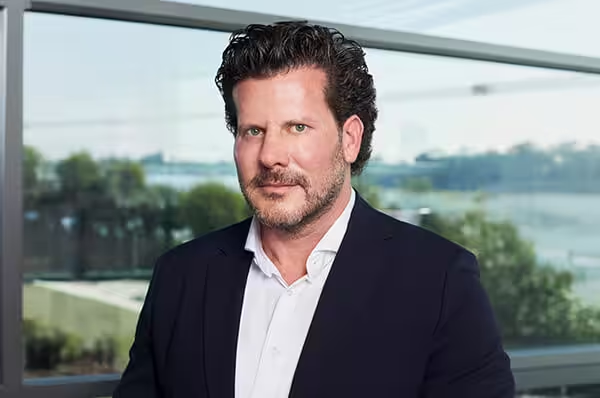
Michael Rainer
Rechtsanwalt, Founder & CEO

Marc Klaas
Rechtsanwalt, Partner

Michael Below
Rechtsanwalt, LL.M., Salary Partner




Berlin
Cologne
Hamburg
Düsseldorf
Frankfurt
Munich
Stuttgart
Leipzig
Local. Regional. International.
How MTR Legal Builds Your AML Compliance
How MTR Legal Structures and Achieves AML Compliance / Money Laundering Prevention Mandates
For companies in Regensburg, especially in the automotive and electronics sectors, adhering to money laundering compliance is crucial. This is particularly true for automotive suppliers and electronics companies experiencing growth phases. The stringent requirements of the Anti-Money Laundering Act (AML) demand not only extensive knowledge of the provisions but also their careful implementation. Failures can result in significant fines, underscoring the need for a solid compliance strategy. MTR Legal supports you in meeting complex requirements and minimizing legal risks.
In the context of money laundering prevention, collaboration with MTR Legal typically begins with a comprehensive initial consultation and a detailed analysis of your existing compliance measures. Based on this, our team develops a tailored strategy that considers your specific requirements. Particular attention is paid to the provisions of the Anti-Money Laundering Act (AML), especially regarding the obligation to report suspicious activities and KYC processes. Implementation occurs in clearly defined steps to ensure compliance with all legal requirements. The project's duration depends on the complexity of the corporate structures and specific requirements, but generally takes several weeks.
For you as a client, this means you can focus on your core business while MTR Legal handles the legal aspects of money laundering prevention. Our approach ensures that your compliance measures not only meet legal requirements but are also effectively integrated into daily business operations. Through close collaboration with you, we ensure that all relevant processes run smoothly and that you are optimally prepared for any audits.
Common Oversights in Money Laundering Prevention
What Clients Often Overlook Without Legal Guidance
In a city like Regensburg, distinguished by its burgeoning industry, adhering to money laundering compliance is crucial for many companies. This is especially true for sectors like automotive suppliers and electronics companies involved in growth financing or investment structuring. Implementing money laundering compliance according to the Anti-Money Laundering Act (AML) is a complex process that poses significant risks without legal advice. Without the necessary experience, companies may unknowingly violate regulations, leading to substantial fines. The importance of this issue is often underestimated, particularly regarding the obligation to report suspicious activities and the effective implementation of Know-Your-Customer (KYC) processes.
The biggest challenge for companies often lies in correctly implementing the requirements of the Anti-Money Laundering Act. A common mistake is the inadequate identification and verification of business partners. This can lead to entering into business relationships with high-risk partners without fulfilling the required due diligence. Another critical point is the failure to submit suspicious activity reports in a timely manner, exposing companies to the risk of sanctions. Additionally, the documentation of measures taken must be comprehensive and traceable to withstand scrutiny by authorities.
For clients, this means that support from an experienced legal team can be crucial in efficiently and correctly implementing legal requirements. MTR Legal offers well-founded advice in this context to minimize individual risks and fully meet legal obligations. This not only strengthens the company's legal security but also protects it from potential reputational damage and financial losses.
Step by Step to a AML-Compliant Organization
Phases, Deadlines, and Documents — A Structured Overview
Implementing AML compliance is crucial for companies in Regensburg, especially for sectors like automotive suppliers and electronics companies, which are strongly represented here. Companies that fail to meet the requirements of the Anti-Money Laundering Act (AML) risk significant fines. Introducing effective KYC processes (Know Your Customer) and correctly submitting suspicious activity reports are essential steps to minimize legal risks and maintain the company's integrity. In a dynamic economic location like Regensburg, it is vital to comply with legal obligations to secure the trust of business partners and investors.
The process of AML compliance begins with a risk analysis that must be conducted within a specified timeframe. Companies are required to regularly review and adjust their internal procedures to meet the requirements of § 10 AML. In practice, this means that relevant documents such as identity proofs and financial calculations must be collected and analyzed promptly. The obligation to report suspicious activities requires that a report be submitted to the relevant authorities without delay when concrete indications are present. These steps are not only legally mandated but also necessary to create a solid basis for business decisions.
For MTR Legal clients, this means that a proactive approach to money laundering prevention must be developed. By collaborating with our team, tailored compliance strategies can be created that meet the specific requirements of your company. Timely implementation of necessary measures not only reduces the risk of sanctions but also enhances operational efficiency. Our locations offer you the opportunity to receive legal support in close proximity to the economic centers of Regensburg.
Frequently Asked Questions about Money Laundering Prevention
Concise Answers to Typical AML Compliance / Money Laundering Prevention Questions
What is the goal of money laundering compliance?
Money laundering compliance aims to protect the integrity of the financial system by ensuring that companies adhere to the provisions of the Anti-Money Laundering Act (AML). This includes identifying and verifying customers (KYC processes), detecting and reporting suspicious transactions, and implementing internal security measures. These measures are intended to prevent criminal funds from entering the legitimate economic cycle. Companies thus avoid fines and legal consequences that may arise from non-compliance.
When must a company submit a suspicious activity report?
A suspicious activity report is required when a company has indications that a transaction is related to money laundering or terrorism financing. This may be the case if the origin of the funds is unclear or the transaction appears unusual. The report must be submitted promptly to the Financial Intelligence Unit (FIU). Companies should ensure that their employees are trained to recognize such signs to respond in a timely manner.
What costs are involved in implementing money laundering compliance?
The costs of implementing money laundering compliance vary depending on the size of the company and the complexity of business processes. Typically, expenses are incurred for developing and implementing internal policies, training employees, and deploying IT solutions to monitor transactions. Additionally, external consultants may be engaged to ensure that all AML requirements are met. Investing in compliance can avoid fines and reputational damage in the long term.
How does a KYC process work?
The KYC process (Know Your Customer) begins with identifying the customer by collecting and verifying personal data and documents, such as ID and proof of address. A risk assessment is then conducted to determine the customer's potential money laundering risk. Depending on the risk profile, ongoing monitoring of the business relationship occurs. The KYC process is essential to ensure that all customers act in compliance with the law and do not support illegal activities.
Structure and Duties of the Money Laundering Officer
Contact, Initial Assessment, and Clear Roadmap
Compliance with money laundering regulations is crucial for companies in Regensburg, especially for players in the automotive and electronics sectors, which are strongly represented here. Non-compliance can lead to significant fines and damage the trust of business partners and customers. For companies operating in a dynamic industrial environment like Regensburg, it is essential to implement a robust system for adhering to money laundering regulations. This not only protects against legal sanctions but also strengthens market position.
A central element of money laundering compliance is adhering to the suspicious activity reporting obligation under the Anti-Money Laundering Act. Companies must ensure they have effective Know-Your-Customer (KYC) processes in place to identify and report suspicious activities early. The obligation to submit a suspicious activity report is not only a legal requirement but also a protective mechanism for the company itself. Consistent implementation of these processes requires a deep understanding of the legal framework and a strategic approach to avoid disrupting business operations.
For clients, this means that well-founded legal advice is essential. MTR Legal offers a clearly structured advisory process that begins with a comprehensive initial consultation. Based on this, we develop a tailored strategy for implementing money laundering compliance requirements. With our experience in advising companies in highly regulated industries, we can ensure that our clients are optimally positioned both legally and practically.
Sanctions for AML Violations
Key Aspects for In-depth Understanding
Adhering to money laundering compliance is crucial for companies, especially those in the emerging industrial city of Regensburg. Companies in the automotive supply and electrical engineering sectors face the challenge of implementing the legal requirements of the Anti-Money Laundering Act (AML). This involves not only fulfilling legal obligations but also protecting the company from legal and financial risks. Failure to comply can result in significant fines and jeopardize the trust of business partners and customers. Therefore, it is essential to be aware of the importance of this issue and take appropriate measures.
In the field of money laundering prevention, specialized legal knowledge is required to understand and implement the complex requirements of the AML. Particularly important are the mechanisms for identifying and verifying business partners, known as "Know Your Customer" (KYC) processes. These processes are crucial for early detection of suspicious transactions and, if necessary, submitting a suspicious activity report. The obligation to submit such a report can arise from § 43 AML and requires careful consideration and documentation. Failures in this area can lead not only to financial sanctions but also to significant reputational damage for the company.
For clients, this means that comprehensive advice and implementation of compliance measures are essential. MTR Legal supports you in efficiently implementing legal requirements and adjusting internal processes accordingly. This not only minimizes the risk of fines but also lays the foundation for long-term business relationships. Our teams help you develop a tailored strategy that meets the specific requirements of your company.
Need Legal Assistance?
MTR Legal Regensburg offers professional legal advice. Let’s find the best solution together.
Interfaces between Tax Law and AML
Key Aspects of Tax Considerations Explained in Detail
The tax aspects of money laundering compliance are of significant importance for companies in Regensburg, as compliance with legal requirements can have both legal and financial consequences. For companies in Regensburg, particularly in the automotive and electronics sectors, it is essential to precisely implement the requirements of the Anti-Money Laundering Act (AML) to avoid fines and not jeopardize business growth. Proper money laundering prevention can also strengthen the trust of investors and business partners, which is advantageous in a competitive environment.
The tax obligations under the AML include implementing Know-Your-Customer (KYC) processes, which ensure the identification and monitoring of business partners. Companies must ensure, according to § 10 AML, that they have all necessary information to submit suspicious activity reports in a timely manner. This affects not only operational compliance but also tax transparency and documentation obligations. Errors in implementation can lead to significant tax reassessments, as inadequate documentation may raise suspicions of tax evasion.
For clients, this means that close collaboration with a legally knowledgeable team is essential to meet the complex requirements of the AML. MTR Legal offers comprehensive support in developing and implementing tailored compliance strategies. This ensures that companies not only minimize legal risks but also guarantee tax clarity and security. Timely and precise advice can be crucial to avoid unwanted financial consequences.
Due Diligence in Customer Relationships
Current Legislation, Rulings, and Their Impact on Clients
Adhering to money laundering compliance is crucial for companies in Regensburg, especially for sectors like automotive suppliers and electronics companies. These companies face the challenge of fulfilling legal requirements for money laundering prevention to avoid the risk of fines. The obligation to submit a suspicious activity report and implement KYC processes (Know Your Customer) are central elements. In a dynamic economic environment like Regensburg, characterized by industrial growth and international networking, careful adherence to money laundering regulations is essential to minimize legal and economic risks.
The Anti-Money Laundering Act (AML) provides the legal framework for money laundering prevention in Germany. Companies are required to conduct risk analyses and establish internal security measures to detect potential money laundering activities early. § 2 AML defines the obligated parties, including lawyers, notaries, and real estate agents. Recent rulings emphasize the importance of comprehensive documentation and due diligence in the KYC process. Non-compliance with these regulations can result in significant fines, potentially threatening the existence of companies. Additionally, the legal regulations offer certain leeway to efficiently design internal processes while meeting legal requirements.
For clients, this means that a proactive approach to money laundering compliance is essential. Collaborating with an experienced team like MTR Legal can help develop tailored solutions that provide both legal security and are aligned with the specific needs of the company. By implementing robust compliance structures, companies can not only minimize legal risks but also strengthen the trust of their business partners.
International Money Laundering Standards and FATF
Key Aspects of International Relations and Specifics Explained Concisely
In the international context of money laundering compliance, cross-border transactions and the involvement of foreign business partners play a central role. For companies in Regensburg, especially in the automotive supply and electrical engineering sectors, adhering to international standards is essential to avoid legal risks. International connections require a precise understanding of the respective foreign regulations and their interactions with the German Anti-Money Laundering Act (AML). Compliance with these standards is not only a legal obligation but also a crucial factor in securing the company's reputation and avoiding fines.
Key legal aspects include implementing the Fifth EU Money Laundering Directive, which requires companies to conduct comprehensive Know-Your-Customer (KYC) processes. These processes involve verifying the identity of business partners and tracking transactions across borders. Companies must ensure that they submit suspicious activity reports in a timely manner according to § 43 AML when there are indications of money laundering. Non-compliance with these obligations can lead to significant fines, potentially reaching millions. Therefore, it is essential for companies to continuously review and adjust their compliance systems.
For clients, this means they must act proactively and regularly review existing compliance processes. MTR Legal supports you in efficiently implementing the necessary adjustments and offers advice to ensure that all legal requirements are met. Through close collaboration with our locations, you benefit from tailored solutions that meet the specific challenges faced by internationally active companies.
AML Checklist for Your Company
Key Aspects of a Practical Checklist Explained Concisely
Implementing money laundering compliance is crucial for companies in Regensburg, especially for sectors like the automotive and electronics industries. In a city heavily influenced by industries such as mechanical engineering and electrical engineering, adhering to the provisions of the Anti-Money Laundering Act (AML) poses a significant challenge. Companies that fail to meet this obligation risk significant fines and legal consequences. In an emerging industrial location like Regensburg, it is essential for automotive suppliers and electronics companies to effectively structure their compliance processes to minimize legal risks and not hinder their growth.
The essential mechanisms of money laundering prevention include identifying and verifying business partners and continuously monitoring transactions. According to § 10 AML, companies are required to verify their customers' identities and promptly report suspicious activities. This requires precise Know-Your-Customer processes (KYC) to meet legislative requirements. A well-structured checklist can help systematically tackle the various tasks. From documenting customer information to regularly training employees, numerous aspects must be considered to meet legal requirements and effectively implement the obligation to report suspicious activities.
For clients, this means they must regularly review and adjust their internal processes and structures. Collaboration with an experienced legal team, such as MTR Legal, can be crucial here. We support you in optimizing your compliance measures and minimizing legal risks. This allows you to focus on your core business while we ensure that your money laundering prevention measures meet legal requirements.