

ESG Compliance – Sustainability Law & Supply Chain Due Diligence for Mannheim
Corporate Criminal Law
LkSG Compliance in Mannheim: Fulfilling Supply Chain Obligations Securely
Mannheim entrepreneurs and clients trust MTR Legal
In Mannheim, one of the economic centers of the Rhine-Neckar metropolitan region, compliance with the Supply Chain Act (LkSG) is particularly important for companies in mechanical and plant engineering. The proximity to major IT companies like SAP in Walldorf highlights the relevance of digitization and automation in the region. For Mannheim entrepreneurs, implementing due diligence under the LkSG is crucial to identify risks early and avoid sanctions. The consequences of non-compliance can be significant, potentially amounting to up to 2% of annual turnover. Therefore, a thorough risk analysis is essential for Mannheim companies to meet the requirements and prevent financial losses.
MTR Legal in Mannheim is your reliable partner when it comes to implementing LkSG compliance. With extensive client experience and an interdisciplinary approach, MTR Legal offers tailored solutions for the specific challenges of medium-sized companies in Mannheim. Our team possesses the necessary knowledge to help you effectively meet complex legal requirements. Rely on our experience and consult with our team in Mannheim to establish a solid foundation for your compliance strategy.
- Kaiserring 14-16, 68161 Mannheim
- +49 621 76021230
- mannheim@mtrlegal.com
5000+
Mandate
Team
Experienced Attorneys
Global
International Presence
8
Offices
Competence that Convinces.
Utilize our expertise für Mannheim and book a consultation to address your concerns professionally.
MTR Legal in Mannheim: ESG Compliance Securely Structured
From Analysis to Outcome — MTR Legal in Mannheim
- Supply Chain Act: Who is Affected and What to Do
- Legal Requirements of the LkSG and the CSRD
- ESG Compliance in Mannheim: Legal Foundations
- How MTR Legal Builds Your LkSG Compliance
- Typical Compliance Gaps in the Supply Chain Act
- Step by Step to a LkSG-Compliant Organization
- Frequently Asked Questions about LkSG Compliance
- Risk Analysis under LkSG: What Needs to be Examined
- Handling Identified Risks in the Supply Chain
International Representation
As a member of the international network of lawyers IR Global, we are your point of contact for cross-border matters and represent you in an international context.
Supply Chain Act: Who is Affected and What to Do
Key Aspects of the Supply Chain Act at a Glance
The Supply Chain Act presents companies with the challenge of implementing due diligence obligations throughout their entire supply chain. Especially in an economic hub like Mannheim, which is heavily influenced by mechanical engineering, compliance with these regulations is crucial. Companies with more than 1,000 employees must ensure they meet the standards set by the law to avoid risks such as fines. These fines can amount to up to 2% of annual turnover, which could significantly impact a company's financial health. The complexity of the requirements necessitates careful planning and implementation to avoid legal and economic damage.
From a professional standpoint, the Supply Chain Act requires companies to conduct a comprehensive risk analysis and take preventive measures. The requirements are embedded in the legal provisions of the act, with the implementation of due diligence obligations being a central point. Companies must not only monitor their direct suppliers but also the entire supply chain. This requires close collaboration with partners and continuous monitoring to fulfill the risk analysis obligation. Violations can result in not only financial penalties but also long-term damage to the company's reputation.
For clients, this means they must act proactively to meet the legal requirements of the Supply Chain Act. MTR Legal assists companies in efficiently tackling these challenges. Our team provides comprehensive advice on ESG compliance and develops tailored solutions aligned with the specific needs and structures of the company. This helps minimize risks and ensure compliance with legal requirements.
Legal Requirements of the LkSG and the CSRD
Current Legislation, Rulings, and Their Impact on Clients
The implementation of due diligence obligations under the Supply Chain Act (LkSG) is crucial for companies in Mannheim and across Germany. Especially for compliance officers and executives in the Rhine-Neckar metropolitan region, the issue is essential as it involves avoiding sanctions that can amount to up to 2% of annual turnover. In a region characterized by mechanical engineering and large industrial companies, the risk of non-compliance with legal requirements must be minimized. The pressure is increasing as compliance with ESG standards is increasingly demanded by investors and business partners.
The legal framework for ESG compliance is complex and encompasses various national and international regulations. At the core is the Supply Chain Act, which applies to companies with more than 1,000 employees. Companies are required to conduct a comprehensive risk analysis to identify and mitigate human rights and environmental risks in their supply chains. Recent developments and rulings have further clarified the requirements, obligating companies to take and document preventive measures. This also includes reporting on compliance as prescribed in § 3 LkSG.
For MTR Legal's clients, this means they must act proactively and adjust their internal processes accordingly. Legal advice and support from our team can be crucial in efficiently meeting complex requirements and avoiding potential sanctions. Early and comprehensive implementation of due diligence obligations is not only legally required but also a competitive advantage in the globalized economy.
ESG Compliance in Mannheim: Legal Foundations
Direct Contacts, Structured Mandates, Clear Communication
For companies in Mannheim, a central economic hub of the Rhine-Neckar metropolitan region, the implementation of ESG standards is becoming increasingly important. The introduction of due diligence obligations under the Supply Chain Act (LkSG) presents new challenges for compliance officers and executives. Conducting a risk analysis is not only a legal requirement but also a crucial factor for sustainable business practices. Especially for medium-sized companies in mechanical engineering, failing to meet these obligations can result in significant financial consequences, including sanctions of up to 2% of annual turnover.
The Supply Chain Act requires companies to examine their supply chains for human rights and environmental risks. The central mechanism is the risk analysis, which includes identifying and assessing potential risks. It forms the basis for all further compliance measures. If violations are detected, companies are obliged to take remedial actions and enhance their reporting. The penalties for non-compliance are substantial and can jeopardize a company's financial stability. Therefore, it is crucial that companies implement their compliance strategies precisely and timely.
Our team at MTR Legal in Mannheim guides you through the entire ESG compliance process. We offer structured consulting approaches tailored to your company's individual needs. With our in-depth knowledge of the Supply Chain Act, we assist you in effectively fulfilling your legal obligations. With clear communication and a personal consulting style, we are your reliable partner in successfully implementing ESG requirements in your company.
Create Clarity – Now!
For legal clarity and strategic foresight – our team in Mannheim is ready to support you. Don’t hesitate to contact us.
Your Team
Competent. Assertive. Successful.
In Mannheim, the MTR Legal team offers personal and structured advice in the field of ESG compliance. Our approach aims to work collaboratively with our clients and develop tailored solutions for the specific challenges of their business. Clients can expect comprehensive support from us in implementing due diligence obligations under the Supply Chain Act, which is both legally sound and practical.
Our team in Mannheim focuses on risk analysis and the implementation of compliance strategies to avoid sanctions of up to 2% of annual turnover. With a deep understanding of the needs of medium-sized companies, especially in mechanical and plant engineering, we are the ideal partner to successfully navigate companies in the Rhine-Neckar metropolitan region through the challenges of the Supply Chain Act. Our experience enables us to develop individual solutions that are both legally and economically viable. Contact us to achieve your compliance goals with us.
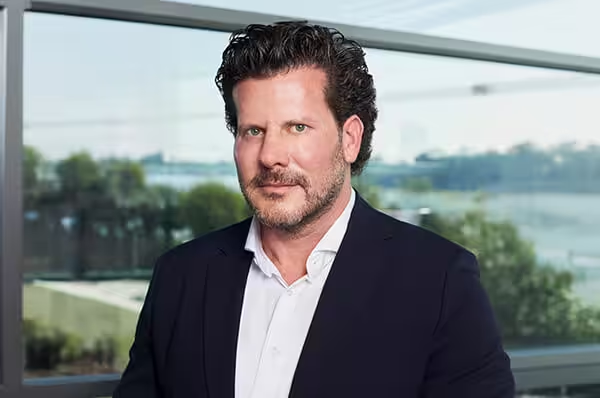
Michael Rainer
Rechtsanwalt, Founder & CEO

Marc Klaas
Rechtsanwalt, Partner

Michael Below
Rechtsanwalt, LL.M., Salary Partner




Berlin
Cologne
Hamburg
Düsseldorf
Frankfurt
Munich
Stuttgart
Leipzig
Local. National. International.
How MTR Legal Builds Your LkSG Compliance
How MTR Legal Structures and Achieves ESG Compliance Mandates
The implementation of due diligence obligations under the Supply Chain Act (LkSG) is crucial for companies in Mannheim, particularly for the dominant mechanical and plant engineering sector. Compliance officers and executives face the challenge of accurately analyzing and minimizing risks in the supply chain. Non-compliance can result in sanctions of up to 2% of annual turnover, which can have significant financial implications, especially for large companies. MTR Legal supports companies in strategically overcoming these challenges and establishing a legally secure position.
The process begins with a comprehensive initial consultation, where the specific requirements and challenges of the company are discussed. This is followed by a detailed risk analysis based on the Supply Chain Act guidelines. The MTR Legal team then develops a tailored compliance strategy that considers the company's specific circumstances. Concrete implementation steps are defined to ensure the company meets the LkSG requirements. The practical consequence of these measures is a sustainable reduction of legal risks and an enhancement of corporate reputation.
For the client, this means gaining not only legal security but also the ability to focus on core competencies while MTR Legal professionally manages ESG compliance. The typical timeframe for implementing these measures can vary depending on the company's size and the complexity of the supply chain, but the structured approach ensures efficient and goal-oriented execution.
Typical Compliance Gaps in the Supply Chain Act
What Clients Often Overlook Without Legal Guidance
For companies in Mannheim, implementing due diligence obligations under the Supply Chain Act (LkSG) is crucial, especially for compliance officers and executives of larger firms. The economic significance of the region and the dominance of industries such as mechanical engineering and IT increase the urgency to correctly implement legal requirements. Without solid legal support, companies risk neglecting key aspects such as the risk analysis obligation, leading to significant penalties. These can amount to up to 2% of annual turnover and have substantial financial impacts. Therefore, it is essential to fully understand and correctly implement the LkSG requirements.
A common misunderstanding in implementing the LkSG lies in the inadequate consideration of the risk analysis. This analysis is not merely a formal act but requires an in-depth examination of the entire supply chain. Companies relying solely on internal resources often overlook critical risks that may arise from suppliers. An incomplete risk analysis can result in potential weaknesses in the supply chain going undetected, ultimately leading to legal and financial consequences. The LkSG mandates that these analyses be continuously updated to account for new developments. Without legal advice, companies risk not fully meeting these complex requirements.
For MTR Legal's clients, this underscores the need to integrate legal experience early in the compliance process. Our team's advice can help avoid common mistakes and ensure that all legal obligations are comprehensively fulfilled. This not only prevents sanctions but also strengthens the company's market position and reputation. A legally sound implementation of due diligence obligations under the LkSG is therefore not only a legal necessity but also a strategic decision.
Step by Step to a LkSG-Compliant Organization
Phases, Deadlines, and Documents — A Structured Overview
The implementation of due diligence obligations under the Supply Chain Act (LkSG) is of great importance for companies, especially in economically strong Mannheim, where mechanical engineering plays a central role. Companies with more than 1,000 employees face the challenge of meeting the LkSG requirements on time. This is not only relevant from a regulatory perspective but also to avoid potential sanctions of up to 2% of annual turnover. A structured approach enables the efficient handling of complex requirements while securing the company's competitiveness.
The first step in ESG compliance is the risk analysis, which serves as the basis for further measures. This should be conducted within the first three months after the obligation takes effect. Following this, a prevention concept must be created and implemented. Internal processes should be documented, and appropriate measures for risk minimization should be established. An annual report on due diligence obligations according to § 8 LkSG is required. Documenting these steps is essential to demonstrate compliance with legal requirements in case of an audit by the authorities.
For compliance officers and executives, this means establishing a continuous process that ensures regular review and adjustment of measures. MTR Legal supports you in implementing the legal requirements of the LkSG in your company. Our team offers legal advice and practical solutions to efficiently manage complex requirements and position your company for the future.
Frequently Asked Questions about LkSG Compliance
Concise Answers to Common ESG Compliance Questions
What is the Supply Chain Act and who does it affect?
The Supply Chain Act, also known as the Supply Chain Due Diligence Act (LkSG), obliges companies to uphold human rights and environmental due diligence obligations in their supply chain. It applies to companies based in Germany with more than 3,000 employees. From 2024, the threshold will be lowered to 1,000 employees. The goal is to minimize human rights violations and environmental damage along supply chains. Companies must undertake risk analysis and prevention measures to meet these requirements.
When must a company conduct a risk analysis under the LkSG?
A risk analysis under the LkSG must be conducted regularly to identify potential human rights and environmental risks in the supply chain. It is particularly necessary when entering new business relationships or when existing supply chains change significantly. The aim of the risk analysis is to develop preventive measures and adjust existing processes to identify and counteract risks early. The results of the risk analysis should be documented and regularly reviewed.
What sanctions are imposed for violations of the Supply Chain Act?
Companies face significant sanctions for violations of the Supply Chain Act. These can include fines of up to 2% of the average annual turnover. Additionally, companies may be excluded from public contract awards. The exact amount of the sanctions depends on the severity and duration of the violation. Companies are therefore well-advised to take compliance with due diligence obligations seriously and establish appropriate compliance structures to avoid sanctions.
How does the implementation of due diligence obligations under the LkSG work?
The implementation of due diligence obligations under the LkSG begins with the establishment of a compliance management system that includes risk analyses, preventive measures, and reporting. Companies must clarify internal responsibilities and set up appropriate processes to ensure compliance with obligations. This also involves training employees and involving suppliers. Implementation should be regularly reviewed and adjusted to new legal or business developments. Documentation and transparency are essential.
Risk Analysis under LkSG: What Needs to be Examined
Key Aspects of LkSG Risk Analysis at a Glance
The LkSG Risk Analysis is crucial for companies in Mannheim and beyond, as it is a key component of ESG compliance. In the economic center of the Rhine-Neckar metropolitan region, where mechanical engineering and industry dominate, companies are required to implement the due diligence obligations of the Supply Chain Act (LkSG). This obligation primarily affects compliance officers and executives of companies with over 1,000 employees. A thorough risk analysis is essential to avoid legal sanctions, which can amount to up to 2% of annual turnover. For Mannheim companies operating in mechanical or plant engineering, this is particularly relevant as they often manage complex supply chains.
The professional depth of the LkSG risk analysis requires a sound understanding of the legal framework. Companies must engage with specific legal requirements, such as the due diligence obligations described in § 4 LkSG. These include identifying and assessing risks throughout the entire supply chain. The results must be comprehensively documented to meet legal requirements. The practical consequence for companies is that they must establish internal processes and control mechanisms to identify and mitigate potential risks early. An inadequate risk analysis can lead to significant legal and financial consequences.
For clients, this means they must act proactively and integrate the risk analysis into their business processes. MTR Legal supports this by developing tailored solutions for implementing LkSG requirements. Our team accompanies you through every phase of the process, from risk identification to documentation, ensuring that your company is not only legally protected but also operates sustainably and responsibly.
Need Legal Assistance?
MTR Legal Mannheim offers professional legal advice. Let’s find the best solution together.
Handling Identified Risks in the Supply Chain
Key Aspects of Handling Identified Risks Explained Concisely
Handling identified risks in the supply chain is crucial for companies in Mannheim and beyond. Through the Supply Chain Act (LkSG), companies are obligated to implement due diligence obligations to recognize and minimize risks in their supply chain early. Especially in the economically strong Mannheim region, characterized by its mechanical and plant engineering, companies must ensure they meet the ESG compliance requirements. Adhering to these obligations not only protects against financial sanctions, which can amount to up to 2% of annual turnover, but also helps preserve the company's reputation.
Legally, companies are required under the LkSG to conduct a comprehensive risk analysis. This analysis aims to identify potential human rights and environmental risks along the entire supply chain. The obligation to conduct a risk analysis is not just a formal requirement but a central mechanism to prevent violations of human rights and environmental standards. Companies must implement appropriate preventive measures and continuously monitor them to ensure that identified risks are effectively managed. Non-compliance can lead to significant legal consequences that extend beyond financial penalties.
For executives and compliance officers, this means taking proactive steps to meet the LkSG requirements. This includes training employees, adjusting internal processes, and collaborating with partners along the supply chain. MTR Legal assists companies in developing tailored compliance programs that meet specific requirements. Through our legal advice, Mannheim companies can ensure they not only fulfill legal obligations but also uphold their corporate responsibility.