

ESG Compliance – Sustainability Law & Supply Chain Due Diligence for Kassel
Corporate Criminal Law

LkSG Compliance in Kassel: Securely Fulfilling Supply Chain Obligations
Clear strategies, legally secure implementation — ESG Compliance with MTR Legal
In Kassel, a significant hub for automotive suppliers and mechanical engineering companies, the issue of supply chain due diligence under the Supply Chain Act (LkSG) is gaining increasing importance. Companies in the region, especially those undergoing transformation or succession planning, face the challenge of conducting comprehensive risk analyses to avoid severe penalties of up to 2% of annual turnover. For companies in Kassel closely linked to the VW plant or operating in the fields of mechanical engineering and renewable energy, the legally secure implementation of due diligence is crucial to ensure competitiveness and legal security.
MTR Legal is the ideal partner in Kassel to support companies in implementing LkSG compliance. With an experienced team and interdisciplinary experience, MTR Legal offers comprehensive advice specifically tailored to the needs of automotive suppliers and medium-sized production companies. The firm combines deep legal understanding with practical solutions to provide compliance officers and executives with clear and actionable strategies. Consult with our team in Kassel to sustainably and securely shape your compliance strategy.
- Zentgrafenstr. 128, 34130 Kassel
- +49 561 98448350
- kassel@mtrlegal.com
5000+
Mandate
Team
Experienced Attorneys
Global
International Presence
8
Offices
Competence that Convinces.
Utilize our expertise für Kassel and book a consultation to address your concerns professionally.
ESG Compliance in Kassel: Consulting on Equal Terms
Structured advice, clear communication, measurable results
- Supply Chain Act: Who is Affected and What Needs to be Done
- Legal Requirements of LkSG and the CSRD
- ESG Compliance in Kassel: Legal Foundations
- How MTR Legal Builds Your LkSG Compliance
- Typical Compliance Gaps in the Supply Chain Act
- Step by Step to a LkSG-Compliant Organization
- Frequently Asked Questions about LkSG Compliance
- Risk Analysis under LkSG: What Needs to be Examined
- Handling Identified Risks in the Supply Chain
International Representation
As a member of the international network of lawyers IR Global, we are your point of contact for cross-border matters and represent you in an international context.
Supply Chain Act: Who is Affected and What Needs to be Done
Legal classification and practical consequences
The Supply Chain Act is becoming increasingly significant for companies in Kassel, particularly for automotive suppliers and mechanical engineers. With the introduction of this law, companies must strengthen their due diligence obligations within supply chains and conduct comprehensive risk analyses. These measures are crucial to meet legal requirements and avoid potential penalties that can amount to up to 2% of annual turnover. For compliance officers and executives of large companies, this is a major challenge that requires a proactive approach.
The Supply Chain Act obliges companies to conduct systematic risk analyses to identify and minimize human rights violations and environmental offenses in their supply chains. The legal requirements are particularly anchored in the paragraphs of the law that provide for specific due diligence and reporting obligations. Practically, this means that companies must establish robust compliance structures to meet legal requirements. Failure to fulfill these obligations can result in sanctions that are not only financial in nature but can also sustainably damage the company's reputation.
For companies needing support in implementing the requirements of the Supply Chain Act, MTR Legal offers comprehensive advice. Our team helps develop and implement the necessary compliance structures to minimize legal risks. This allows executives and compliance officers to ensure that their company not only complies with legal requirements but also builds sustainable business relationships. This is particularly important for companies in transformation or succession planning, as is often the case in Kassel.
Legal Requirements of LkSG and the CSRD
What has changed and what it means for your situation
The implementation of ESG compliance is crucial for companies in Kassel and beyond. Especially for automotive suppliers and medium-sized production companies, which are strongly represented in the region, the requirements for adhering to environmental, social, and governance standards are increasing. The Supply Chain Act (LkSG) obliges companies to fulfill due diligence obligations along their supply chains. These obligations are essential to minimize risks and avoid high penalties. Non-compliance can result in fines of up to 2% of annual turnover, which can have significant financial consequences for large companies.
The legal requirements in the area of ESG compliance are clearly defined by the Supply Chain Act. Companies must conduct a risk analysis to identify potential violations in their supply chain. This includes compliance with human rights and environmental standards. Recent rulings and developments show that courts strictly monitor compliance with these obligations. However, the legislator has granted companies leeway to develop individual compliance strategies. This is particularly relevant in dynamic industries such as mechanical engineering and the automotive supply industry, where adaptability is crucial.
For compliance officers and executives, this means they must act proactively to meet the requirements of the LkSG. A well-founded risk analysis and the implementation of appropriate measures are essential. The team at MTR Legal is at your side to develop tailored solutions that legally secure your business processes while considering the specific circumstances of your company.
ESG Compliance in Kassel: Legal Foundations
From initial consultation to implementation — MTR Legal in Kassel
ESG compliance consulting is becoming increasingly important for companies in Kassel. Especially for automotive suppliers and medium-sized production companies, which are strongly represented in the region, the careful implementation of due diligence obligations according to the Supply Chain Act (LkSG) is crucial. Companies with more than 1,000 employees face the challenge of conducting comprehensive risk analyses to avoid penalties of up to 2% of annual turnover. In this context, the MTR Legal team in Kassel offers valuable support by developing tailored solutions that meet the specific requirements of the industry.
The Supply Chain Act requires companies to take a structured approach to ESG compliance. By implementing mechanisms for risk analysis and reporting, potential violations can be identified and averted early. Individual consulting by the MTR Legal team plays a central role in this. With a focus on personal and equal-level consultation, the team enables clients to efficiently meet the complex requirements of the LkSG. The legal framework and specific requirements of ESG compliance are conveyed in an understandable and practical manner.
For companies in Kassel, collaborating with MTR Legal means they can rely on a partner who understands transformation and succession planning in the automotive and mechanical engineering industries. Legally sound advice and individual support in implementing due diligence obligations under the LkSG form the basis for sustainable corporate governance. This way, clients can not only minimize legal risks but also secure their competitiveness in the long term.
Create Clarity – Now!
For legal clarity and strategic foresight – our team in Kassel is ready to support you. Don’t hesitate to contact us.
Your Team
Competent. Assertive. Successful.
Our team in Kassel is characterized by a personal and structured consulting philosophy. We work on equal terms with our clients to develop tailored solutions in the area of ESG compliance. You can expect us to understand your specific requirements and implement them purposefully. Our dedicated approach ensures that you receive optimal support at every stage of the collaboration.
In Kassel, our focus is on implementing due diligence obligations under the Supply Chain Act. Our team helps you meet the requirements for risk analyses and minimize the risk of penalties, which can amount to up to 2% of annual turnover. With in-depth knowledge and practical experience, we are your ideal partner to identify and manage compliance risks early. Contact us to learn more about how we can support your company.
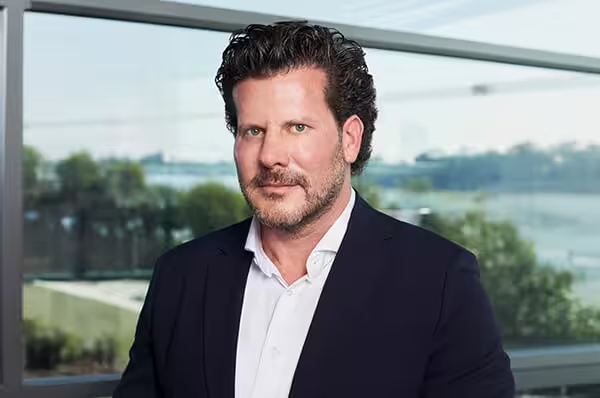
Michael Rainer
Rechtsanwalt, Founder & CEO
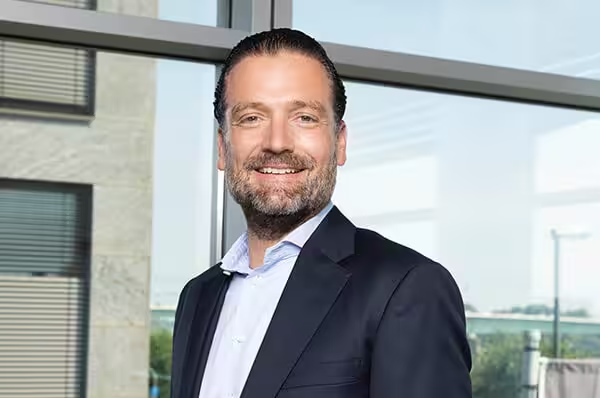
Marc Klaas
Rechtsanwalt, Partner

Michael Below
Rechtsanwalt, LL.M., Salary Partner




Berlin
Cologne
Hamburg
Düsseldorf
Frankfurt
Munich
Stuttgart
Leipzig
Local. National. International.
How MTR Legal Builds Your LkSG Compliance
Initial consultation, concept, implementation — clear and comprehensible
The implementation of due diligence obligations under the Supply Chain Act is crucial for companies in Kassel, especially for automotive suppliers and medium-sized production companies. These companies face the challenge of conducting complex risk analyses to avoid penalties of up to 2% of their annual turnover. MTR Legal supports compliance officers and executives in developing a solid understanding of the legal requirements and effectively integrating them into the corporate strategy. The precise implementation of the requirements not only contributes to fulfilling legal obligations but also strengthens the company's sustainable positioning in the region.
MTR Legal's consulting approach begins with a comprehensive initial consultation, analyzing the specific challenges of the client. Subsequently, a tailored strategy is developed, aimed at fulfilling the due diligence obligations under the Supply Chain Act. This includes identifying and evaluating risks along the entire supply chain. The legal requirements, particularly the risk analysis obligation, are considered in detail. Practical consequences include the introduction of monitoring mechanisms and documentation processes to ensure compliance with legal requirements and avoid penalties.
For clients, this means that by collaborating with MTR Legal, they not only gain legal security but also the opportunity to sustainably and future-proof their business processes. Legally sound advice and support in implementing due diligence obligations lead to improved compliance performance and strengthen the company's market position in a competitive environment.
Typical Compliance Gaps in the Supply Chain Act
Identify risks early — avoid damages and liability
The implementation of due diligence obligations under the Supply Chain Act (LkSG) is crucial for companies in Kassel, especially for automotive suppliers and medium-sized production companies. A key aspect is the risk analysis obligation, which should not be underestimated by executives and compliance officers with over 1,000 employees. Errors in this area can have far-reaching consequences, including penalties of up to 2% of annual turnover. Without legal advice, companies risk not recognizing weaknesses in their compliance structure in time, which can lead to liability risks.
Typical errors in ESG compliance often arise from inadequate risk analyses and lack of monitoring of supply chain partners. Companies that neglect their due diligence obligations risk violating the Supply Chain Act. Incomplete documentation of risks or the absence of preventive measures can result in significant fines. The Supply Chain Act requires a clear definition and implementation of due diligence obligations along the entire supply chain. Non-compliance can not only lead to financial penalties but also sustainably damage the company's reputation.
For clients, this means they must proactively take measures to review and optimize their compliance strategies. Support from the MTR Legal team can ensure that all legal requirements of the LkSG are met and potential risks are identified early. Well-founded advice helps minimize liability risks and protect the company against possible sanctions. This not only ensures compliance with legal requirements but also strengthens long-term competitiveness.
Step by Step to a LkSG-Compliant Organization
What happens in which order and how long it takes
The implementation of due diligence obligations under the Supply Chain Act (LkSG) is crucial for companies with over 1,000 employees. Especially in an economically driven location like Kassel, where many automotive suppliers are based, compliance with LkSG requirements requires precise planning and execution. The legislator provides for substantial penalties, which can amount to up to 2% of annual turnover if due diligence obligations are not properly fulfilled. Compliance officers and executives must therefore understand the timeline of implementation to minimize risks and meet legal requirements.
The process usually begins with a comprehensive risk analysis, which can take several weeks depending on the complexity of the supply chains. This analysis identifies potential human rights violations and environmental offenses. Subsequently, guidelines and procedures for risk minimization are created, which must be approved by management. According to § 3 LkSG, companies must carefully maintain and regularly update these documents. The implementation of measures and employee training follow and can take several months. Practical consequences include regular reporting and reviewing compliance with established standards to ensure sustainable compliance.
For clients, this means they should start planning early to implement all steps on time and efficiently. In drafting the required documents and legal advice, MTR Legal is at your side to ensure that companies meet the requirements of the LkSG. Well-founded legal support can help avoid potential errors and protect the company's financial stability.
Frequently Asked Questions about LkSG Compliance
The most common questions — answered clearly and understandably
What are the main requirements of the Supply Chain Act (LkSG)?
The Supply Chain Act obliges companies to comply with human rights and environmental standards along their entire supply chain. This includes conducting a risk analysis, establishing preventive measures, and setting up a grievance mechanism. Companies with more than 1,000 employees must ensure they fulfill their due diligence obligations to identify and avoid potential risks for human rights violations early. Violations can result in penalties of up to 2% of annual turnover.
When must a company start implementing the LkSG?
Companies that fall within the scope of the Supply Chain Act must start implementing the requirements by January 1, 2023, at the latest. This primarily affects companies with more than 3,000 employees. From 2024, the law also applies to companies with more than 1,000 employees. Early implementation is advisable to meet the complex requirements in time and avoid possible penalties. A well-founded risk analysis is a central component.
What costs can arise from implementing the LkSG?
Implementing the Supply Chain Act can be associated with significant costs. These vary depending on the size of the company and the complexity of the supply chain. Typical cost factors include setting up a compliance management system, conducting risk analyses, and employee training. Additionally, external consultant costs may arise to comprehensively meet legal requirements. Investment in compliance measures can, however, minimize risks in the long term and strengthen the company's image.
How does the risk analysis under the LkSG proceed?
The risk analysis is a central component of the Supply Chain Act. It involves identifying and assessing human rights and environmental risks in the supply chain. Companies should proceed systematically and include all relevant stages of the supply chain. The analysis occurs in several steps: data collection, risk assessment, and deriving measures. The goal is to recognize risks early and act preventively. Regular updates of the analysis are required to respond to changes in the supply chain.
Risk Analysis under LkSG: What Needs to be Examined
Legal classification and practical consequences
The implementation of due diligence obligations under the Supply Chain Act (LkSG) is of immense importance for large companies, particularly in the automotive supply and mechanical engineering sectors in Kassel. The obligation to conduct a comprehensive risk analysis ensures that companies review their supply chains for human rights and environmental risks. In the Kassel region, where numerous medium-sized production companies operate, compliance with these obligations is essential to avoid legal sanctions and secure sustainable business relationships. Risks that are not identified and documented could have significant impacts on the company, including financial penalties and reputational loss.
The risk analysis under the LkSG requires a systematic methodology to identify potential risks within the supply chain. Companies must ensure, according to § 3 LkSG, that this analysis is regularly updated and covers all relevant supply chain stages. Documenting the results is crucial to demonstrate compliance with legal requirements and serve as a basis for further compliance measures. Practically, this means increased effort for compliance departments, which now have extended reporting and documentation obligations. Non-compliance can lead to sanctions amounting to up to 2% of a company's global annual turnover, which is of significant financial importance, especially for larger companies.
For companies in Kassel operating in the automotive and mechanical engineering sectors, this means they must adjust their compliance strategies to meet the new requirements. MTR Legal assists by developing tailored solutions for risk analysis and documentation. Our team helps companies secure themselves legally and make processes as efficient as possible. This allows our clients to focus on their core business while simultaneously meeting the requirements of the LkSG.
Need Legal Assistance?
MTR Legal Kassel offers professional legal advice. Let’s find the best solution together.
Handling Identified Risks in the Supply Chain
Legal classification, risks, and action options
Handling identified risks in the supply chain is of paramount importance for companies in Kassel. Particularly for automotive suppliers and medium-sized companies undergoing transformation, compliance with due diligence obligations under the Supply Chain Act (LkSG) is essential to avoid legal sanctions. Risks in the supply chain can have significant impacts on a company's reputation and business results. Therefore, a comprehensive risk analysis is mandatory to identify and address potential weaknesses early. Companies must ensure that their processes meet ESG compliance requirements, which is also important for succession planning.
The Supply Chain Act challenges companies with more than 1,000 employees to conduct a comprehensive risk analysis. According to the provisions, they are obliged to identify and minimize human rights and environmental risks in their supply chain. Non-compliance can result in sanctions of up to 2% of annual turnover. A central component of ESG compliance is § 3 LkSG, which details the due diligence obligations. Practically, this means that companies must fulfill continuous monitoring and reporting obligations. Implementing these measures requires close interdisciplinary collaboration and a well-founded understanding of the legal framework.
For clients, this means they should proactively initiate risk minimization measures. MTR Legal supports you in implementing the complex requirements of the LkSG in a legally compliant manner and managing the associated risks. Our team's experience helps you develop tailored solutions that meet the specific requirements of your industry. This allows you to focus on your core competencies while effectively fulfilling compliance requirements.