


Business Transfer § 613a BGB – M&A Employment Law & Employee Rights for Frankfurt
Business Transfer § 613a BGB – Employee Rights in M&A for Frankfurt
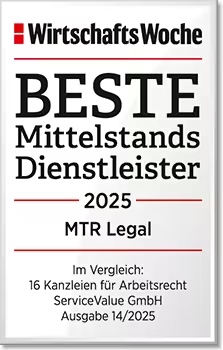


M&A Employment Law (§ 613a) in Frankfurt: Legally Secure Positioning
Clear strategies, legally secure implementation — M&A Employment Law (§ 613a) with MTR Legal
In Frankfurt am Main, the financial hub of continental Europe, corporate and business unit acquisition transactions in the investment banking and private equity sectors are commonplace. For clients in these industries, M&A employment law, particularly § 613a BGB, is of paramount importance. The automatic transfer of all employees in a business sale, coupled with information obligations and employees’ right to object, presents a complex challenge. Investment bankers and PE managers, in particular, must ensure that these legal requirements are precisely adhered to in order to facilitate smooth transactions.
MTR Legal is the right partner in Frankfurt am Main to tackle such challenges in M&A employment law. The firm offers extensive experience in handling complex transactions and is interdisciplinary in its approach to meet the specific needs of clients. With a deep understanding of the legal intricacies and economic implications of such processes, MTR Legal assists in the legally secure implementation of § 613a BGB. Consult with our team in Frankfurt am Main to ensure your transactions are secure and efficient.
- Wiesenhüttenplatz 25, 60329 Frankfurt am Main
- +49 69 945198890
- frankfurt@mtrlegal.com
5000+
Mandate
Team
Experienced Lawyers
Global
Operating Internationally
8
Offices
Competence that Convinces.
Utilize our expertise für Frankfurt and book a consultation to address your concerns professionally.
MTR Legal – Your Attorneys for M&A Employment Law (§ 613a) in Frankfurt
Structured advice, clear communication, measurable results
- M&A Employment Law (§ 613a): What Clients Need to Know
- M&A Employment Law (§ 613a) in Frankfurt: Legal Foundations
- In Which Transaction Scenarios Does § 613a BGB Apply?
- MTR Legal's Approach to M&A Employment Law (§ 613a) Mandates
- Typical Mistakes in M&A Employment Law (§ 613a): What Clients Should Avoid
- Process and Timeline: M&A Employment Law (§ 613a) Step by Step
- Frequently Asked Questions about M&A Employment Law (§ 613a)
- M&A Employment Law (§ 613a) with MTR Legal: Your Next Step
- In-Depth: Special Cases and Specific Topics
- Tax Aspects in Detail
- Legal Foundations of M&A Employment Law (§ 613a)
Internationally Represented
As a member of the international network of lawyers IR Global, we are your contact for cross-border matters and represent you in an international context.
M&A Employment Law (§ 613a): What Clients Need to Know
What M&A Employment Law (§ 613a) entails and when action is required
In the dynamic environment of company acquisitions and sales, especially in a financial center like Frankfurt am Main, M&A employment law plays a crucial role. § 613a BGB is central here, as it governs the automatic transfer of employment relationships in a corporate or business unit acquisition. For buyers and sellers of businesses, this means they must address the legal requirements and consequences of such a transfer early on. Particularly in industries like investment banking and private equity, which are strongly represented here, mishandling these regulations can pose significant financial and operational risks.
§ 613a BGB obligates the acquirer of a company or business unit to take over all existing employment relationships. This includes the duty to inform employees about the planned transfer. Additionally, employees have the right to object to this transfer, which can lead to unexpected personnel challenges. The practical consequence is that both buyers and sellers must ensure that all information obligations are correctly fulfilled before the transaction. Otherwise, legal disputes or the loss of valuable employees may occur, which is particularly significant in complex M&A transactions in the financial services sector.
For MTR Legal’s clients, this means that legal advice is essential to minimize risks when acquiring or selling a company. Our team assists you in correctly navigating § 613a BGB and initiating the necessary steps to comply with all legal obligations. This allows you to focus on the strategic aspects of your transaction while we handle the legal details.
M&A Employment Law (§ 613a) in Frankfurt: Legal Foundations
From initial consultation to implementation — MTR Legal in Frankfurt am Main
M&A employment law, particularly § 613a BGB, is of central importance for companies in Frankfurt am Main. In corporate or business unit acquisitions, the automatic transfer of employees is a focal point. This also affects investment bankers and PE managers who frequently deal with complex M&A transactions in the financial metropolis of Frankfurt. The regulations of § 613a BGB protect employees’ rights and obligate employers to detailed information obligations. For MTR Legal’s clients, it is crucial to understand these legal requirements and integrate them into their transaction strategies.
In detail, § 613a BGB stipulates that in the event of a business transfer, all existing employment relationships automatically transfer to the acquirer. This requires precise planning, as the information obligations towards employees must also be met. Additionally, employees have the right to object, which can prevent the transfer of their employment relationships. For Frankfurt companies operating in private equity and real estate, this has far-reaching consequences. Strategic advice from the MTR Legal team helps to master these challenges in a structured manner and minimize legal risks.
For the client, this means that early and comprehensive advice is indispensable. The MTR Legal team in Frankfurt am Main offers personal and structured support at eye level. Through close collaboration, we ensure that all legal requirements in M&A employment law transactions are met. Our experience helps to make the process efficient and proactively avoid potential conflicts with employees.
Legal Foundations of M&A Employment Law (§ 613a)
What Has Changed and What It Means for Your Situation
§ 613a BGB is of central importance for buyers and sellers of companies or company parts. In Frankfurt am Main, one of Europe’s most important financial centers, M&A transactions are commonplace. The section governs the automatic transfer of all employment relationships in a business transfer and is thus a key aspect in structuring corporate transactions. For investment bankers and private equity managers involved in complex M&A transactions, it is crucial to understand the legal obligations and risks associated with a business transfer to avoid legal pitfalls.
A central element of § 613a BGB is the information obligation towards employees. Employers must inform their employees about the transfer, the legal, economic, and social consequences, and the planned measures in detail. Additionally, employees have the right to object to the transfer of their employment relationship. In recent years, case law has tightened the requirements for providing information, limiting the contractual parties’ room for maneuver. For HR departments and M&A boards, this means they must plan carefully and adhere precisely to the legal framework to ensure the transaction’s success.
For companies in Frankfurt am Main operating in the financial and real estate sectors, it is crucial to make strategic decisions in line with the provisions of § 613a BGB. MTR Legal offers comprehensive advice to ensure that all legal requirements are met. We assist you in correctly fulfilling information obligations and minimizing potential risks. This allows you to conduct your M&A transactions efficiently and legally securely.
Create Clarity – Now!
For legal clarity and strategic foresight – our team is ready to support you. Don’t hesitate to contact us.
Your Team
Competent. Assertive. Successful.
Our team in Frankfurt am Main is characterized by a personal and structured approach that operates at eye level with our clients. As a client, you can expect us to handle your concerns in the area of M&A employment law, particularly in the context of § 613a BGB, with the utmost precision and care. We place great emphasis on understanding your individual needs and developing tailored legal solutions that meet your requirements.
The core competencies of our team include the legal support of corporate and business unit acquisitions, particularly with regard to the automatic transfer of employees, compliance with information obligations, and the right to object. MTR Legal is your ideal partner to navigate this complex legal area. Our deep experience and understanding of the specific challenges that arise in a financial center like Frankfurt make us the first choice. Contact us to address your legal questions in M&A employment law in a targeted and efficient manner.

Michael Rainer
Rechtsanwalt, Founder & CEO

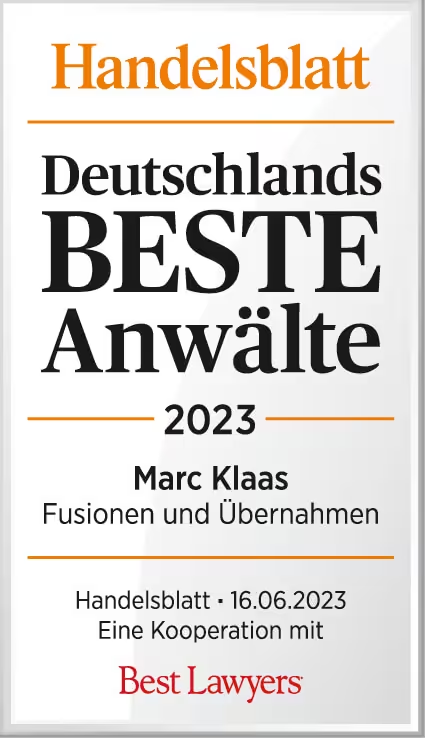
Marc Klaas
Rechtsanwalt, Partner

Michael Below
Rechtsanwalt, LL.M., Salary Partner




Berlin
Cologne
Hamburg
Düsseldorf
Frankfurt
Munich
Stuttgart
Leipzig
Local. Regional. International.
In Which Transaction Scenarios Does § 613a BGB Apply?
Typical Applications and Clients at a Glance
Asset Deal with Transfer of Business Units
An asset deal with the transfer of business units ensures that a company’s assets, including its business units, are efficiently transferred. Especially in Frankfurt am Main, as a financial center, a smooth transition is crucial to continue operations without interruption. § 613a BGB governs the automatic employee transfer, meaning all existing employment relationships transfer unchanged to the new owner. This minimizes uncertainties and protects employee rights. Buyers benefit from being able to continue working with the existing staff without extensive renegotiations.
Outsourcing of Services and Functions
In the outsourcing of services and functions, § 613a BGB can play a central role. Companies in Frankfurt am Main looking to outsource certain areas must ensure that affected employees are correctly informed and their rights preserved. The automatic transfer of employees ensures that outsourcing contracts run smoothly without jeopardizing the continuity of services provided. This allows companies to focus on their core competencies while specialized service providers take over the outsourced tasks.
Carve-out of a Division or Subsidiary
The carve-out of a division or subsidiary is a complex process where § 613a BGB can play a significant role. Companies operating in Frankfurt am Main that wish to divest certain business units must ensure that the employment relationships of affected employees are properly transferred. This prevents legal uncertainties and allows the buyer to seamlessly integrate the division or subsidiary into their own company. The advantage lies in the clear structuring and continuation of business activities without loss of know-how.
Acquisition from Insolvency (Transferred Restructuring)
In the acquisition from insolvency, also known as transferred restructuring, § 613a BGB provides the legal basis for preserving jobs. In an economically challenging environment like Frankfurt am Main, it is crucial that when rescuing an insolvent company, employees are seamlessly integrated into the new operation. The automatic transfer of employment relationships ensures that the new owner can access existing know-how without delay while preserving employee rights. This facilitates restructuring and improves the prospects for a successful business revival.
MTR Legal’s Approach to M&A Employment Law (§ 613a) Mandates
Initial Consultation, Concept, Implementation — Clear and Understandable
In the dynamic economic environment of Frankfurt am Main, corporate and business unit acquisition transactions are of central importance. Especially regarding employment law and specifically § 613a BGB, employers face complex challenges. This section governs the automatic transfer of all employees in a business transfer. For buyers and sellers, it is essential to understand and correctly implement the associated legal obligations, as failure to do so can lead to significant legal and financial consequences. MTR Legal offers comprehensive legal support in this context, specifically tailored to the needs of clients in the financial and real estate sectors.
MTR Legal’s work begins with a detailed initial consultation to clarify the client’s specific requirements and objectives. Based on this, a careful analysis of existing employment contracts and the impact of § 613a BGB is conducted. A critical point is the information obligation towards employees, which must be timely and comprehensive to preserve the employees’ right to object. MTR Legal develops a tailored strategy that considers both legal and business aspects. Implementation is carried out in close coordination with the client and the parties involved. A realistic timeline is also established to ensure the transaction is as smooth and efficient as possible.
For the client, this means above all security and clarity in a legally demanding process. Through MTR Legal’s professional advice and support, legal pitfalls can be avoided, and the success of the transaction ensured. Especially in an international financial center like Frankfurt, it is crucial to rely on an experienced team that precisely navigates the complex requirements of M&A employment law.
Typical Mistakes in M&A Employment Law (§ 613a): What Clients Should Avoid
Recognize Risks Early — Avoid Damages and Liability
The regulations of § 613a BGB are of particular importance in the context of corporate and business unit acquisitions, especially in a dynamic city like Frankfurt am Main, where M&A transactions are frequent. For buyers and sellers of businesses, as well as HR departments in M&A processes, numerous pitfalls lurk. A common mistake is overlooking the automatic assumption of all employees, which can lead to unexpected costs and legal obligations. The information obligations towards employees are also often underestimated, which can lead to conflicts and potential claims for damages. These risks can have significant impacts on the transaction’s profitability.
The technical complexity of § 613a BGB lies in the mechanisms of the automatic transfer of employment relationships. Without adequate legal advice, a buyer may inadvertently assume obligations they had not planned for. Another risk is the employees’ right to object, which allows them to prevent the transfer of their employment relationships. If this right is not correctly communicated, labor disputes may arise, delaying or increasing the cost of the transaction. For example, inadequate information letters can lead to employees successfully contesting the transfer, resulting in retroactive liability.
For clients, this underscores the necessity of involving legal experience early on to minimize potential risks and ensure a smooth transaction. MTR Legal offers comprehensive advice in such cases to meet the statutory requirements of § 613a BGB and secure the strategic goals of the transaction. This is especially important for Frankfurt investment bankers and private equity managers navigating complex M&A transactions.
Process and Timeline: M&A Employment Law (§ 613a) Step by Step
What Happens in What Order and How Long It Takes
In the context of M&A employment law according to § 613a BGB, the process typically begins with a comprehensive legal due diligence review. This involves analyzing the current status of employment contracts and company agreements to identify risks and obligations. After completing this review, the negotiation and drafting of the purchase agreement take place, considering the employment law aspects of the transfer. This phase can take several weeks to months, depending on the complexity of the company and the number of employees involved.
In implementing § 613a BGB, the proper notification of employees is particularly crucial. The employer must inform the workforce in a timely manner about the upcoming business transfer. The notification must include all essential details, including the timing and the legal, economic, and social consequences. Inadequate or delayed information can lead to legal disputes. It is also important to observe the objection period for employees, which begins after the notification. These mechanisms are critical to ensuring a smooth transition.
For employers in Frankfurt am Main, it is advisable to clarify the legal framework early and prepare appropriate measures for employee information. The attorneys at MTR Legal support you in making all necessary steps in the M&A process legally secure and ensuring compliance with legal regulations to avoid any negative consequences.
Need Legal Assistance?
MTR Legal offers comprehensive and professional legal advice. Let’s find the best solution together.
Frequently Asked Questions about M&A Employment Law (§ 613a)
The Most Common Questions — Clearly and Understandably Answered
What Does § 613a BGB Regulate in a Corporate or Business Unit Acquisition?
§ 613a BGB regulates the automatic transfer of employment relationships in a business transfer. This means that all existing employment relationships with their rights and obligations transfer to the new owner. The acquirer thus enters into the existing employment contracts without requiring employee consent. This protects employees from dismissals solely due to the transfer. It is important to note that the new owner cannot change the existing employment conditions without further ado.
What Information Obligations Exist in a Business Transfer?
In a business transfer, both the former and the new owner are obligated to comprehensively inform the affected employees. The information must be provided in writing and in a timely manner, including details about the timing of the transfer, the legal, economic, and social consequences, and planned measures. This information obligation is essential as it forms the basis for the employees’ right to object. Inadequate information can result in the objection period not commencing.
What Is the Right of Objection for Employees in a Business Transfer?
Employees have the right to object to the transfer of their employment relationship to the new owner. This objection must be made within one month of receiving the information about the business transfer. The objection means that the employment relationship remains with the previous employer. However, employees should carefully consider the consequences of an objection, as this may lead to the termination of their employment by the old employer if no other position is available.
How Does a Business Transfer Affect Existing Collective Agreements and Company Agreements?
Existing collective agreements and company agreements initially continue to apply after a business transfer. The new owner is bound by these regulations until they are replaced by new agreements. However, these regulations can be changed after one year if the collective agreements or company agreements are replaced by other regulations. Any change in conditions must comply with legal requirements and employee representation co-determination.
M&A Employment Law (§ 613a) with MTR Legal: Your Next Step
Experienced Advice on M&A Employment Law (§ 613a) — Whenever You Need It
§ 613a BGB takes on particular significance in the context of corporate or business unit acquisitions, especially in a dynamic financial center like Frankfurt am Main. For buyers and sellers of businesses, understanding the legal framework is crucial to minimize risks and identify optimization potentials. A central topic is the automatic transfer of all employees to the acquirer, which entails extensive information obligations and a right of objection for employees. These regulations require careful planning and execution to avoid legal pitfalls and ensure the smooth progression of the transaction.
§ 613a BGB ensures that in the event of a business transfer, existing employment relationships transfer unchanged to the new owner. In practice, this means that the buyer assumes not only the assets but also the employment law obligations. The information obligation towards employees is a critical point, as they must be comprehensively and timely informed about the planned transfer to correctly preserve their right to object. Failures in this area can lead to significant legal consequences that could jeopardize the transaction’s success.
For clients, this means that sound legal guidance is indispensable. At MTR Legal, we support you from the initial analysis through the development of a tailored strategy to successful implementation. Our extensive experience in M&A employment law ensures that all aspects of a business transfer are carefully addressed, considering § 613a BGB. Rely on our team to make your transactions legally secure and efficient.
In-Depth: Special Cases and Specific Topics
Legal Classification and Practical Consequences
In corporate or business unit acquisitions, § 613a BGB plays a central role as it governs the automatic transfer of all employment relationships to the new owner. In Frankfurt am Main, a significant financial center, such transactions are particularly relevant for investment bankers and private equity managers who regularly face complex M&A transactions. Compliance with legal requirements is crucial to minimize legal risks and facilitate a smooth transition. A thorough understanding of obligations and rights is essential to safeguard the interests of all parties involved.
§ 613a BGB stipulates that in the transition of a business or business unit, all employment relationships transfer to the acquirer. This entails obligations to comprehensively inform employees. Additionally, employees have the right to object to the transfer, which can have far-reaching consequences for personnel planning. In practice, this means that the buyer must develop a strategy early on to handle information obligations and objection rights in a legally secure manner. A violation can not only lead to legal disputes but also jeopardize the planned integration of the workforce.
For clients in Frankfurt am Main, who are frequently involved in international M&A transactions, the correct implementation of § 613a BGB is essential. MTR Legal assists in mastering these legal challenges. Our team develops tailored solutions to efficiently fulfill information obligations and minimize objection risks. This not only ensures legal security but also facilitates the smooth integration of employees. This is particularly important for companies operating in a dynamic market environment and relying on flexible personnel structures.
Tax Aspects in Detail
Legal Classification, Risks, and Action Options
In the context of M&A transactions in Frankfurt am Main, a significant financial center, the tax aspects of § 613a BGB are of considerable importance. This section governs the automatic transfer of employees in a corporate or business unit acquisition. For buyers and sellers, it is essential to understand the associated tax implications, as they directly impact the transaction structure and financial planning. The city is known for its complex M&A transactions, where investment bankers and private equity managers regularly face these challenges.
§ 613a BGB stipulates that in a business transfer, all existing employment relationships transfer to the new owner. This means that the buyer is also responsible for all tax obligations of the transferred employees, including income tax and social security contributions. Additionally, the buyer must inform employees in a timely and comprehensive manner about the transfer to consider the statutory right of objection. Failures in this area can lead to significant legal and financial risks, underscoring the need for careful legal review.
For clients, this means that early involvement of legal advice is essential to minimize tax risks. MTR Legal supports you in identifying all relevant legal obligations and integrating them into the transaction planning. Through precise preparation and advice, potential conflicts can be avoided, and the transaction can be made smoother.