

ESG Compliance – Sustainability Law & Supply Chain Due Diligence for Dusseldorf
Corporate Criminal Law

LkSG Compliance in Dusseldorf: Meeting Supply Chain Obligations Securely
From initial consultation to implementation: ESG Compliance in Dusseldorf
In Dusseldorf, an international business hub, companies are increasingly facing the requirements of the Supply Chain Due Diligence Act (LkSG). Especially in leading industries in Dusseldorf such as trade, exhibitions, and international corporations, implementing the required due diligence is essential. Compliance officers and executives of companies with over 1,000 employees face the challenge of conducting comprehensive risk analyses to avoid sanctions of up to 2% of annual turnover. For clients such as Dusseldorf family offices or international corporate managers, it is crucial to identify and mitigate legal risks early on.
MTR Legal in Dusseldorf is your proficient partner in meeting these complex requirements. Our firm has extensive client experience and a strong interdisciplinary approach tailored specifically to the needs of international and national companies. With well-founded advice and practical solutions, we support you in fulfilling your compliance obligations efficiently and securely. Talk to our team in Dusseldorf to proactively address the challenges of the LkSG and strengthen your corporate security.
- Fürstenwall 172, 40217 Düsseldorf
- +49 211 54553080
- duesseldorf@mtrlegal.com
5000+
Mandate
Team
Experienced Attorneys
Global
International Presence
8
Offices
Competence that Convinces.
Utilize our expertise für Dusseldorf and book a consultation to address your concerns professionally.
Legal Advice on ESG Compliance in Dusseldorf
Experienced Team, Clear Strategy, Secure Implementation
- Supply Chain Law: Who is Affected and What to Do
- Legal Requirements of the LkSG and the CSRD
- ESG Compliance in Dusseldorf: Legal Foundations
- How MTR Legal Builds Your LkSG Compliance
- Typical Compliance Gaps in the Supply Chain Law
- Step by Step to a LkSG-compliant Organization
- Frequently Asked Questions about LkSG Compliance
- Risk Analysis under LkSG: What Needs to be Examined
- Handling Identified Risks in the Supply Chain
International Representation
As a member of the international network of lawyers IR Global, we are your point of contact for cross-border matters and represent you in an international context.
Supply Chain Law: Who is Affected and What to Do
Supply Chain Law: Navigate Securely with MTR Legal
The Supply Chain Law (LkSG) presents new challenges for companies, particularly in the area of ESG compliance. For executives and compliance officers in Dusseldorf, correct implementation of due diligence is essential to minimize legal risks. Given the international orientation of many Dusseldorf companies, such as the high density of Japanese corporations, a thorough understanding of legal requirements is crucial. The risks of non-compliance are significant, with sanctions of up to 2% of annual turnover possible. Companies must ensure they meet legal requirements to avoid financial and reputational damage.
Technically, the Supply Chain Law requires a comprehensive risk analysis along the entire supply chain. According to § 4 LkSG, companies are obliged to identify and assess potential risks to human rights and environmental standards. This analysis forms the basis for implementing preventive measures. Additionally, companies must establish complaint mechanisms under § 6 LkSG to address grievances. The legal requirements necessitate a close integration of IT and compliance systems to efficiently capture and process the required data. Practically, this means companies need to review and potentially adjust their internal structures.
For clients, this means careful planning and implementation of LkSG requirements is indispensable. MTR Legal assists companies in securely fulfilling these complex requirements. Our team offers comprehensive advice to develop individual compliance strategies and minimize risks. Through our experience, we help you efficiently implement the required due diligence and position your company for future success.
Legal Requirements of the LkSG and the CSRD
Overview of Legal Framework for ESG Compliance
ESG compliance is an increasingly important issue for companies, especially in an international business hub like Dusseldorf. Implementing due diligence under the Supply Chain Law (LkSG) is a legal necessity to uphold environmental, social, and governance standards. For companies with over 1,000 employees, compliance with these regulations is essential to avoid both legal sanctions and reputational damage. The relevance arises not only from the direct obligation for risk analysis but also from potential sanctions that can amount to 2% of annual turnover. It is crucial for companies to not only know but also effectively implement the legal requirements.
The legal framework for ESG compliance is significantly shaped by the Supply Chain Law. Companies are required to conduct risk analyses and establish measures to prevent violations. § 3 LkSG sets out the due diligence obligations companies must observe. These include identifying and assessing risks and implementing preventive measures. Recent rulings and developments in ESG compliance highlight the importance of a proactive approach. Companies must not only meet the minimum legal requirements but also continuously adapt their internal processes to meet changing legal demands.
For companies, this means that implementing ESG compliance is not a one-time task but an ongoing process. MTR Legal can support you in efficiently and securely implementing legal requirements. Our team has the necessary experience and experience to analyze your company's specific needs and develop tailored solutions. This ensures that your company is not only legally compliant but also sustainably successful.
ESG Compliance in Dusseldorf: Legal Foundations
Your Team in Dusseldorf for All ESG Compliance Matters
Implementing due diligence under the Supply Chain Law (LkSG) is of particular importance for companies in Dusseldorf. As an international business hub with a high density of Japanese companies and significant trade fairs, many firms face the challenge of adapting their compliance strategies. Compliance with the LkSG is not only a legal obligation but also a key component of corporate social responsibility, which strengthens the trust of investors and partners. In Dusseldorf, where international corporate structures and family offices are present, a thorough risk analysis is crucial to avoid potential sanctions and maintain reputation.
The Supply Chain Law requires companies to conduct comprehensive risk analyses regarding human rights and environmental standards. According to § 3 LkSG, companies must identify potential risks in their supply chains and take appropriate remedial measures. Non-compliance can result in sanctions of up to 2% of annual turnover. This regulation forces companies to rethink their internal processes and establish an effective compliance management system. Our MTR Legal team in Dusseldorf supports you in tackling these challenges in a structured and collaborative manner.
For clients, this means that close collaboration with a legally savvy team is essential to efficiently implement the LkSG requirements. MTR Legal offers you personal and structured advice specifically tailored to the needs of companies in Dusseldorf. Our approach ensures not only legal compliance but also strengthens your position in the international business environment. Rely on our experience to achieve your ESG compliance goals.
Create Clarity – Now!
For legal clarity and strategic foresight – our team in Dusseldorf is ready to support you. Don’t hesitate to contact us.
Your Team
Competent. Assertive. Successful.
Our team in Dusseldorf is characterized by a personal and structured approach that always operates at eye level with our clients. In an international business hub like Dusseldorf, where numerous international corporations and family offices operate, we understand the specific requirements and challenges faced by compliance officers. Our clients can rely on well-founded and practical advice tailored to their individual needs. We guide you through the entire process and ensure that your due diligence obligations under the Supply Chain Law (LkSG) are comprehensively fulfilled.
In the area of LkSG compliance, our focus is on conducting risk analyses, implementing preventive measures, and preparing for potential sanctions that can amount to 2% of annual turnover. MTR Legal is the right partner for you, as we possess extensive knowledge and long-standing experience in supporting international corporate structures and family offices. Our tailored solutions minimize liability risks and enhance the legal security of your company. Contact us to jointly develop the appropriate strategies for your LkSG compliance.
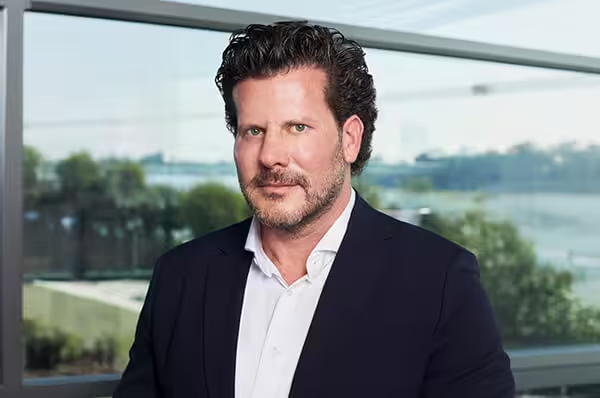
Michael Rainer
Rechtsanwalt, Founder & CEO
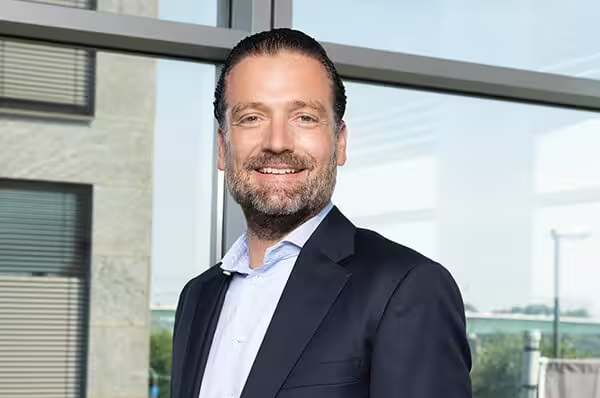
Marc Klaas
Rechtsanwalt, Partner

Michael Below
Rechtsanwalt, LL.M., Salary Partner




Berlin
Cologne
Hamburg
Düsseldorf
Frankfurt
Munich
Stuttgart
Leipzig
Local. National. International.
How MTR Legal Builds Your LkSG Compliance
From Initial Consultation to Outcome — Our Approach
Implementing due diligence under the Supply Chain Law (LkSG) is crucial for companies, especially in an international business hub like Dusseldorf. Here, global supply chains intersect with complex corporate structures. For compliance officers and executives of companies with over 1,000 employees, this means a significant responsibility to minimize risks and avoid sanctions. The Supply Chain Law requires an extensive risk analysis, with non-compliance potentially resulting in sanctions of up to 2% of annual turnover. In Dusseldorf, where many international corporations and family offices operate, precise implementation of these legal requirements is indispensable.
The legal framework of the Supply Chain Law, particularly the risk analysis obligation, requires a detailed examination of the entire supply chain. MTR Legal supports companies in developing an effective strategy that meets the law's requirements. This begins with a comprehensive initial consultation to analyze the specific needs and structures of the client. Subsequently, a tailored strategy is developed that considers all legal aspects. Practical implementation includes integrating compliance measures into the corporate structure to ensure due diligence compliance and avoid potential sanctions.
For the client, this means they can rely on comprehensive legal support that not only meets legal requirements but also develops long-term compliance strategies. MTR Legal accompanies the entire process from analysis to implementation, offering practical solutions tailored to the company. This ensures that all requirements of the Supply Chain Law can be effectively and efficiently implemented.
Typical Compliance Gaps in the Supply Chain Law
Common Pitfalls in ESG Compliance and How to Avoid Them
Implementing due diligence under the Supply Chain Law (LkSG) is of great importance for companies with over 1,000 employees, especially in an international business hub like Dusseldorf. Compliance officers and executives face the challenge of correctly implementing legal requirements to avoid significant sanctions. Errors in risk analysis or implementation can lead to fines of up to 2% of annual turnover. In Dusseldorf, where many international corporations and family offices are based, careful implementation of these obligations is crucial to minimize corporate risks and meet international business relationships.
A common mistake in ESG compliance lies in insufficient risk analysis. Companies acting without legal advice often overlook critical areas of their supply chains, leading to unidentified risks and ultimately violations of the LkSG. The law requires companies to establish systematic processes to identify and assess risks. Without a well-founded analysis and corresponding measures, this could result in not only financial consequences but also reputational damage. Another risk is that companies do not fully meet reporting obligations, which can also lead to sanctions.
For clients of MTR Legal, this means that precise legal advice and guidance in implementing due diligence obligations is essential. Our team assists in optimizing internal processes and ensuring compliance with legal requirements. Through comprehensive advice, companies can not only avoid sanctions but also strengthen their position in international competition.
Step by Step to a LkSG-compliant Organization
Typical Process and Key Milestones in ESG Compliance
Implementing due diligence under the Supply Chain Law (LkSG) is central for companies, especially in a dynamic business hub like Dusseldorf. Here, international corporations and family offices face complex legal requirements. The relevance of the topic arises from the need to identify and mitigate risks along the supply chain early on. Companies must not only meet legal requirements but also secure their reputation and competitiveness. The risk analysis obligation and the possibility of sanctions amounting to 2% of annual turnover make careful planning and execution indispensable.
The ESG compliance process begins with a comprehensive risk analysis, typically taking several weeks. During this phase, potential risks in the supply chain are identified and assessed. Subsequently, the development and implementation of preventive measures tailored to these risks occur. Companies must regularly create reports and documentation to demonstrate compliance with due diligence obligations under § 3 LkSG. These documents are crucial to withstand audits by authorities. The practical consequence for companies is a continuous adjustment of their processes to meet changing legal requirements.
For compliance officers and executives with over 1,000 employees, this means they must proactively respond to the challenges of the LkSG. Support from the MTR Legal team can be crucial in this regard. With well-founded legal advice and tailored solutions, we assist clients in efficiently and legally implementing the necessary steps. This not only ensures compliance with legal requirements but also strengthens the internal organization and external reputation of your company.
Frequently Asked Questions about LkSG Compliance
All Essential Information on ESG Compliance at a Glance
What is the Supply Chain Due Diligence Act (LkSG)?
The Supply Chain Due Diligence Act (LkSG) requires companies to fulfill human rights and environmental due diligence obligations along their supply chains. The aim is to minimize risks such as child labor or environmental damage. Companies with more than 1,000 employees must implement measures for risk analysis and prevention to avoid legal violations. The law provides for sanctions in case of non-compliance, which can amount to 2% of annual turnover. Therefore, it is crucial to establish an effective compliance management system to meet these requirements.
When do I need a risk analysis under the LkSG?
A risk analysis is necessary if your company employs more than 1,000 people and thus falls under the LkSG. The analysis serves to identify and assess potential risks in the supply chain. The goal is to recognize and address human rights or environmental hazards early. This comprehensive assessment is the first step in developing an effective action plan. Without a well-founded risk analysis, there is a risk of high sanctions, which could jeopardize the financial stability of the company.
How does the implementation of LkSG compliance proceed?
The implementation of LkSG compliance begins with a comprehensive risk analysis, followed by the development of specific measures to mitigate risks. This includes establishing complaint mechanisms and monitoring supply chain activities. Companies must also regularly create reports and adjust their compliance measures to respond to new risks. Close collaboration with internal and external partners is crucial to ensure compliance with LkSG requirements and efficiently implement due diligence obligations.
What are the costs of LkSG compliance consulting at MTR Legal?
The costs for LkSG compliance consulting at MTR Legal depend on various factors, such as the extent of required support and the complexity of supply chains. After an initial consultation, we create a customized offer tailored to your company's specific requirements. Careful planning and implementation of compliance measures can save costs in the long term by avoiding potential sanctions and reputational damage. We offer you a transparent cost structure and guide you through the entire process.
Risk Analysis under LkSG: What Needs to be Examined
LkSG Risk Analysis: Navigate Securely with MTR Legal
Implementing due diligence under the Supply Chain Law (LkSG) is crucial for companies with more than 1,000 employees, especially in an international business hub like Dusseldorf. The LkSG risk analysis forms the core of the compliance strategy, as it provides the foundation for securely meeting the new regulations. For executives and compliance officers, it is essential to identify and document potential risks in their supply chains early to avoid both financial and legal sanctions. The relevance of the topic is particularly evident in Dusseldorf, where international corporate structures and family offices with cross-border activities are strongly represented.
At the heart of the LkSG risk analysis is the methodology for identifying and assessing risks along the entire supply chain. Companies must proceed systematically under § 3 LkSG to recognize human rights and environmental risks. This requires extensive data collection and documentation, which must be verifiable both internally and externally. Failures can have severe consequences, as violations of the LkSG can be sanctioned with fines of up to 2% of annual turnover. The challenge lies in efficiently integrating legal requirements into existing business processes without unduly burdening operations.
For clients, this means that careful planning and implementation are imperative. MTR Legal supports this by providing an experienced team that analyzes your company's specific requirements and develops tailored solutions. This not only ensures compliance with legal requirements but also minimizes liability risks. Through our comprehensive advice, we enable you to sustainably optimize your compliance strategy and position yourself securely in a dynamic market environment.
Need Legal Assistance?
MTR Legal Dusseldorf offers professional legal advice. Let’s find the best solution together.
Handling Identified Risks in the Supply Chain
Legally Secured: Handling Identified Risks in the Supply Chain with MTR Legal
In a globally connected economy, the issue of due diligence in the supply chain is of paramount importance, especially for companies in Dusseldorf, an international business hub. Compliance with the requirements of the Supply Chain Due Diligence Act (LkSG) is not only a legal obligation but also a matter of corporate responsibility. Companies that do not adequately analyze and manage risks in their supply chain expose themselves to significant financial and legal sanctions. These can amount to up to 2% of annual turnover. For compliance officers and executives with over 1,000 employees, it is therefore essential to identify and minimize risks early.
The Supply Chain Due Diligence Act requires companies to conduct a risk analysis to identify potential violations of human rights and environmental standards. A central mechanism is the ongoing review of supplier relationships, through which risks are systematically recorded and assessed. This requires the implementation of effective compliance systems that meet the law's requirements. The practical implementation of these requirements is complex and requires comprehensive legal knowledge. Companies must also ensure they comply with the due diligence obligations set out in § 3 LkSG to avoid sanctions.
For companies, this means they must proactively take measures to mitigate risks. MTR Legal supports clients in developing tailored compliance strategies that meet the specific requirements of the LkSG. By accompanying our clients in the implementation and monitoring of these strategies, we help them minimize legal and financial risks and fulfill their corporate responsibility. This ensures that our clients are not only legally secured but also make a positive contribution to sustainability.