

ESG Compliance – Sustainability Law & Supply Chain Due Diligence for Dortmund
Corporate Criminal Law

LkSG Compliance in Dortmund: Legally Secure Fulfillment of Supply Chain Obligations
MTR Legal advises clients in Dortmund on all aspects of ESG Compliance
Dortmund, as a dynamic software city and logistics hub, faces significant challenges with the requirements of the Supply Chain Act (LkSG). For IT entrepreneurs and e-commerce founders based in the city, the legally mandated risk analysis is crucial to ensure compliance and avoid penalties of up to 2% of annual turnover. In a city characterized by IT and software companies, adhering to due diligence obligations becomes a central challenge, especially for companies with over 1,000 employees. Implementing these obligations is not only a legal necessity but also a key factor for sustainable business success.
MTR Legal is the competent partner in Dortmund when it comes to implementing LkSG compliance. The firm has extensive experience advising companies on the complex requirements of supply chain transparency. Thanks to our interdisciplinary approach, we can offer comprehensive solutions that meet both legal and economic demands. Our team in Dortmund supports you in proactively tackling the challenges of the LkSG. Talk to our team in Dortmund to structure your compliance strategy securely.
- Westfalendamm 98, 44141 Dortmund
- +49 231 22819220
- dortmund@mtrlegal.com
5000+
Mandate
Team
Experienced Attorneys
Global
International Presence
8
Offices
Competence that Convinces.
Utilize our expertise für Dortmund and book a consultation to address your concerns professionally.
MTR Legal – Your Attorneys for ESG Compliance in Dortmund
From initial consultation to implementation — legally secured
- Supply Chain Act: Who is Affected and What Needs to be Done
- Legal Requirements of the LkSG and the CSRD
- ESG Compliance in Dortmund: Legal Foundations
- How MTR Legal Builds Your LkSG Compliance
- Typical Compliance Gaps in the Supply Chain Act
- Step by Step to a LkSG Compliant Organization
- Frequently Asked Questions about LkSG Compliance
- Risk Analysis under LkSG: What Needs to be Examined
- Handling Identified Risks in the Supply Chain
International Representation
As a member of the international network of lawyers IR Global, we are your point of contact for cross-border matters and represent you in an international context.
Supply Chain Act: Who is Affected and What Needs to be Done
What clients need to know — background and action options for clients
The Supply Chain Act (LkSG) is becoming increasingly important for companies, especially in a dynamic economic region like Dortmund. Here, where IT and e-commerce companies thrive, the law forms an important foundation for sustainable business practices. For compliance officers and executives with over 1,000 employees, adhering to due diligence obligations becomes mandatory to minimize the risk of sanctions. Given penalties that can amount to up to 2% of annual turnover, a well-founded strategy for implementing the requirements is essential. The obligation to conduct a risk analysis is a central component to identify and address potential violations early.
The Supply Chain Act requires companies to implement due diligence obligations along their entire supply chain. Key legal aspects include the creation of an effective risk management system in accordance with § 3 LkSG. Companies are required to identify, assess, and mitigate risks to human rights and the environment. Practically, this means that firms must not only review their internal processes but also those of their suppliers to ensure compliance with relevant standards. These requirements particularly affect Dortmund-based companies in IT and logistics, which operate in global networks and thus involve a multitude of suppliers.
For clients, this means that a proactive approach to implementing the LkSG requirements is essential. MTR Legal offers support by developing tailored compliance programs that are customized to the specific needs of the company. Our team helps you minimize legal risks while effectively implementing the requirements of the law. This allows you to focus on your core business while ensuring compliance with legal requirements.
Legal Requirements of the LkSG and the CSRD
Legal foundations, current developments, and design options
For compliance officers and executives in Dortmund, implementing the due diligence obligations under the Supply Chain Act (LkSG) is of central importance. The city has developed into a center for IT and e-commerce, making compliance with ESG standards all the more relevant. Companies must ensure that they not only act legally compliant but also avoid potential sanctions that can amount to up to 2% of annual turnover. This requires careful risk analysis along the entire supply chain to ensure the integrity and sustainability of business relationships.
The legal framework for ESG compliance is largely determined by the Supply Chain Due Diligence Act (LkSG). This law obliges companies to assume human rights and environmental due diligence obligations along their supply chains. Recent rulings have further specified the obligations, particularly regarding risk analysis and its documentation. Companies face the practical challenge of implementing these requirements efficiently and cost-effectively to minimize liability risks. There are design options in implementing compliance management systems that allow for tailored solutions to specific business needs.
For clients, this means that a proactive approach is necessary to meet legal requirements while maintaining entrepreneurial flexibility. The team at MTR Legal is at your side to develop legally secure solutions tailored to your individual business models. Especially for Dortmund-based companies active in IT and e-commerce, MTR Legal offers comprehensive support in implementing effective compliance strategies.
ESG Compliance in Dortmund: Legal Foundations
Experienced attorneys for ESG compliance — personal and directly accessible
In today's business world, especially in a dynamic city like Dortmund, compliance with ESG standards (Environmental, Social, Governance) is crucial for a company's sustainable success. For companies operating in IT and e-commerce, the Supply Chain Due Diligence Act (LkSG) poses a particular challenge. The requirements for risk analysis and the implementation of due diligence obligations are complex and can result in significant financial penalties if not met. Therefore, it is essential for compliance officers and executives working for companies with over 1,000 employees to take these compliance tasks seriously and prepare well.
The Supply Chain Due Diligence Act obliges companies to conduct extensive risk analyses and preventive measures to identify and minimize human rights violations and environmental risks along their supply chains. Violations can lead to fines of up to 2% of annual turnover. MTR Legal in Dortmund is ready to support companies in implementing these due diligence obligations under the LkSG. Our team follows a structured and personal approach, enabling our clients to make legally sound decisions on an equal footing. With our experience, we help you achieve your compliance goals and protect your company from financial and legal risks.
For Dortmund-based IT entrepreneurs and e-commerce founders, this means that early and comprehensive compliance measures not only provide legal security but also ensure long-term business success. MTR Legal offers you the necessary support and legal advice in Dortmund to meet the requirements of the LkSG and confidently master the diverse challenges of ESG compliance. Rely on our experience to align your corporate structure with legal requirements.
Create Clarity – Now!
For legal clarity and strategic foresight – our team in Dortmund is ready to support you. Don’t hesitate to contact us.
Your Team
Competent. Assertive. Successful.
Our team at MTR Legal in Dortmund is characterized by a personal and structured working method that always takes place on an equal footing with our clients. In the dynamic environment of Dortmund, where IT companies and e-commerce flourish, we understand the challenges companies face when complying with the Supply Chain Act (LkSG). Clients can expect tailored advice from us that considers both the legal requirements and the individual needs of each company.
In the area of LkSG compliance, our focus is on supporting the implementation of due diligence obligations, conducting comprehensive risk analyses, and developing effective compliance structures. MTR Legal is the right partner to safely navigate companies through the complex requirements of the Supply Chain Act and avoid potential sanctions. Our experience in compliance, IP, IT, and digital enables us to provide targeted solutions that meet the specific challenges of the Dortmund IT and e-commerce sector. Contact us to develop the best possible strategy for your company together.
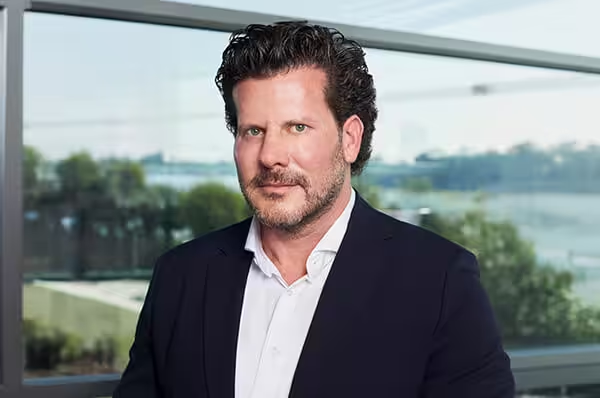
Michael Rainer
Rechtsanwalt, Founder & CEO

Marc Klaas
Rechtsanwalt, Partner

Michael Below
Rechtsanwalt, LL.M., Salary Partner




Berlin
Cologne
Hamburg
Düsseldorf
Frankfurt
Munich
Stuttgart
Leipzig
Local. National. International.
How MTR Legal Builds Your LkSG Compliance
Step by step to a legally secure solution — with MTR Legal by your side
For companies in Dortmund and beyond, implementing the due diligence obligations under the Supply Chain Act (LkSG) is of crucial importance. Given the city's economic transformation into an IT and e-commerce center, companies are increasingly required to update their compliance strategies. Complying with the LkSG requirements is not only a legal necessity but also a central component of responsible corporate governance. Non-compliance can result in penalties of up to 2% of annual turnover, which can have significant financial implications. Therefore, it is essential for compliance officers and executives of large companies to identify and manage risks early.
As part of LkSG compliance, MTR Legal begins with a detailed initial consultation to understand the specific requirements and challenges of the client. Following the initial analysis, strategy development takes place, where tailored solutions for fulfilling the due diligence obligations are developed. Implementation occurs in clearly defined steps to ensure legally secure compliance with the requirements. The risk analysis according to § 3 LkSG is a central component to identify and mitigate potential violations. The timeline varies depending on the size of the company and the complexity of the supply chain, with a typical period of six to twelve months expected.
For clients, this means that by collaborating with MTR Legal, they not only gain legal security but also strengthen the trust of their business partners and customers. Continuous support and advice from the MTR Legal team ensure that companies effectively achieve their compliance goals and can sustain their market presence in the long term.
Typical Compliance Gaps in the Supply Chain Act
Costly mistakes, underestimated risks, and pitfalls at a glance
The implementation of due diligence obligations under the Supply Chain Act (LkSG) is highly relevant for companies in Dortmund, especially for compliance officers and executives of large firms with over 1,000 employees. In Dortmund's dynamic economic landscape, increasingly focused on IT and e-commerce, ESG compliance is not only a legal obligation but also a crucial factor for sustainable growth. Mistakes in implementing these obligations can lead to significant financial penalties and permanently damage the company's image. Therefore, it is essential to know and avoid typical pitfalls.
A common issue is inadequate risk analysis, which is required under § 4 LkSG. Without sound legal advice, companies risk failing to identify or misjudging relevant risks in their supply chain. This can lead to incomplete or incorrect reports, which in turn can result in penalties of up to 2% of annual turnover. Practical consequences are not only financial losses but also damage to the company's reputation. Companies specializing in IT and e-commerce, like many in Dortmund, must also consider that their complex supply chains pose particular challenges in data collection and processing.
For clients, this means that preventive measures and close collaboration with a legal team are crucial to effectively meet the LkSG requirements. MTR Legal supports you in conducting comprehensive risk analyses and developing tailored compliance strategies. This way, companies can not only avoid legal pitfalls but also strengthen and sustainably expand their market position.
Step by Step to a LkSG Compliant Organization
From initial consultation to implementation — timeline and required documents
The implementation of due diligence obligations under the Supply Chain Act (LkSG) is of crucial importance for companies in Dortmund and beyond. Especially for compliance officers and executives of large companies with more than 1,000 employees, this presents a complex task. Compliance with due diligence obligations is not only legally required but also economically relevant to avoid penalties of up to 2% of annual turnover. In a city like Dortmund, which has established itself as a software city and where IT and e-commerce companies thrive, it is essential to structure supply chains according to legal requirements.
The ESG compliance process typically begins with a comprehensive risk analysis, which forms the basis for all subsequent steps. Potential risks in the supply chain are identified and assessed to develop preventive measures based on this. The duration of this analysis can take several weeks, depending on the size and structure of the company. Following the risk analysis, an action plan is created, concretizing the due diligence obligations according to § 3 LkSG. The documentation of these measures and their implementation must be comprehensive to be able to prove compliance with legal requirements in case of an audit.
For clients, this means that they must create the necessary internal structures early to ensure effective implementation of the LkSG requirements. This includes providing appropriate resources and training employees. MTR Legal supports you as a reliable partner in the legal review and implementation of the necessary measures to ensure legally compliant and efficient ESG compliance.
Frequently Asked Questions about LkSG Compliance
Answers to the most important questions about ESG compliance
What are the central due diligence obligations under the Supply Chain Act?
The Supply Chain Act obliges companies to comply with certain due diligence obligations in their supply chains. These include risk analysis to identify human rights and environmental risks, the implementation of preventive measures, and the establishment of a complaint mechanism. Companies must also regularly report on their activities and review their effectiveness. Non-compliance with these obligations can result in penalties of up to 2% of annual turnover. The due diligence obligations aim to improve human rights and environmental standards in global supply chains.
When do I need a risk analysis for my supply chain?
A risk analysis is required if your company employs more than 1,000 people and falls under the Supply Chain Act. The analysis is the first step in fulfilling due diligence obligations and must be conducted regularly to identify potential risks in the supply chain. It is particularly important to conduct an updated risk analysis when there are changes in the supply chain or new business partners. Through risk analysis, preventive measures can be developed to prevent human rights violations and environmental damage.
What costs can arise from implementing due diligence obligations?
The costs of implementing due diligence obligations under the Supply Chain Act can vary, depending on the size and complexity of your supply chain. Major expenses arise from conducting risk analyses, implementing preventive measures and training, and establishing complaint mechanisms. Regular reviews and reporting also incur costs. Companies should understand these expenses as part of compliance costs, which contribute to risk reduction and protection of the company's reputation in the long term.
How does reporting under the Supply Chain Act work?
Companies subject to the Supply Chain Act must report annually on their due diligence obligations. The report should include the risk analyses conducted, preventive measures taken, and the effectiveness of complaint mechanisms. It must be publicly accessible to ensure transparency. Reporting is usually done through the annual report or a separate document. Companies should ensure that the report contains all relevant information to avoid potential penalties for inadequate reporting.
Risk Analysis under LkSG: What Needs to be Examined
Methodology and Documentation — Background and Action Options for Clients
The implementation of due diligence obligations under the Supply Chain Act (LkSG) presents significant challenges for companies in Dortmund. Particularly for IT companies and e-commerce firms in a dynamic growth phase, systematic risk analysis is of central importance. This analysis is not only a legal requirement but also contributes to the long-term security of business processes. A faulty or inadequate analysis carries the risk of sanctions, which can amount to up to 2% of annual turnover. Therefore, it is essential to understand and implement the requirements precisely.
The LkSG risk analysis requires a detailed methodology to identify, assess, and document potential risks along the entire supply chain. Key legal foundations are the provisions of the Supply Chain Act, particularly the obligations under §§ 4 to 10 LkSG. Companies must proceed systematically to recognize human rights and environmental risks. The analysis results must not only be comprehensively documented but also regularly updated. This documentation forms the basis for internal and external audits and is crucial for proving compliance to authorities.
For Dortmund-based companies, this necessitates creating compliance structures that meet the specific requirements of the LkSG. MTR Legal assists in creating a tailored risk analysis and offers practical solutions for efficient implementation of legal requirements. By closely collaborating with our team, legal pitfalls can be avoided, and compliance requirements can be effectively met.
Need Legal Assistance?
MTR Legal Dortmund offers professional legal advice. Let’s find the best solution together.
Handling Identified Risks in the Supply Chain
Handling identified risks in the supply chain — background and practice overview
For companies in Dortmund and beyond, handling identified risks in the supply chain is of central importance. Especially for IT and e-commerce companies, compliance with the due diligence obligations under the Supply Chain Act (LkSG) is essential to avoid sanctions that can amount to up to 2% of annual turnover. These risks relate not only to financial aspects but also to reputation and sustainable business management. Compliance officers and executives in growing companies must ensure that their supply chains meet legal requirements to be successful in the market in the long term.
The Supply Chain Act obliges companies to conduct comprehensive risk analysis of their supply chains. Companies are required to take preventive measures and prepare corresponding reports. Key legal foundations are found in the provisions of the LkSG, which promotes the integration of ESG compliance (Environmental, Social, Governance) into business processes. The practical consequence is that companies must create transparent and verifiable processes to meet the requirements. This includes regular review of supply chains and documentation of the measures taken to prove compliance with all due diligence obligations in case of an audit.
For clients, this means developing precise strategies to identify, assess, and mitigate risks. Here, the team at MTR Legal can provide valuable support in implementing legally secure processes and structures. By identifying and addressing risks early, clients not only secure their market position but also actively contribute to sustainable business development. Close collaboration with legal advisors enables the efficient integration of LkSG requirements and thus avoids potential sanctions.