

Restructuring in Crisis – StaRUG & Protective Shield Proceedings for Cologne
Swift, discreet, and decisive – MTR Legal provides comprehensive support.

Restructuring in Crisis (StaRUG) in Cologne: Legally Secure
Your point of contact in Cologne for all Restructuring in Crisis (StaRUG) matters
Restructuring in crisis is crucial for many businesses in Cologne. Economic uncertainties and unexpected market changes can quickly put companies in a critical situation. It is essential to take the right measures in time to ensure business continuity and regain financial stability. The StaRUG process provides a legal framework to develop and implement restructuring concepts before insolvency occurs. Failure to comply with legal requirements can lead to financial losses and legal consequences for management. Therefore, it is vital to be informed early about existing risks and possible actions.
MTR Legal is your competent partner in Cologne, guiding you through the complex process of restructuring in crisis. Our lawyers assist you in developing tailored solutions that fit your company’s situation. With in-depth knowledge of the StaRUG process, we help secure your company’s future. We invite you to experience our experience and take the next steps with us. Let’s work together to regain your economic stability.
- Breslauer Platz 4, 50668 Köln
- +49 221 9999220
- koeln@mtrlegal.com
5000+
Mandate
Team
experienced lawyers
Global
Internationally active
8
Offices
Competence that convinces.
Utilize our expertise für Cologne and book a consultation to address your concerns professionally.
MTR Legal – Your Lawyers for Restructuring in Crisis (StaRUG) in Cologne
MTR Legal in Cologne: Professionally guiding Restructuring in Crisis (StaRUG)
- Recognizing Crisis and Acting Early
- Restructuring Options: Out-of-Court and In-Court
- Restructuring in Crisis (StaRUG) in Cologne: Legal Foundations
- Insolvency Filing or Self-Administration: Which Path Fits in Crisis
- Director's Liability in Crisis: Duties and Action Options
- Creditor Interests in Crisis: Legal Duties and Scope for Action
- Frequently Asked Questions about Restructuring and the StaRUG Process
- Protective Shield Procedure under § 270b InsO: Opportunities and Limitations
- Self-Administration: Prerequisites and Risks for Directors
Internationally Represented
As a member of the international network of lawyers IR Global, we are your contact for cross-border matters and represent you in an international context.
Recognizing Crisis and Acting Early
Background and the Right Strategy for Clients
Early detection of corporate crises is crucial for timely action. Companies in economic distress often face the challenge of recognizing the first signs of a crisis. These signs include liquidity shortages, declining sales, or increasing liabilities. A proactive approach allows for timely countermeasures, laying the foundation for successful restructuring. Regardless of a company's size, the ability to interpret warning signals early is vital for sustainable stabilization.
The Corporate Stabilization and Restructuring Act (StaRUG) provides a legal framework to effectively address crisis situations. It allows for the early involvement of creditors and the implementation of restructuring plans outside of insolvency proceedings. A key element is the timely creation of a restructuring plan (§ 2 StaRUG), which serves as a guide for restructuring. Companies must be aware of the consequences of delayed reactions. Timely measures not only minimize risks but also build trust with creditors and business partners.
For clients, this means being ready to openly address challenges and react flexibly to changes. Our team in Cologne supports you in initiating the necessary steps and guides you through the entire restructuring process. The focus is on developing tailored solutions that fit your individual situation. Through early consultation and detailed analysis of your company's position, we can set the course for a successful future together.
Restructuring Options: Out-of-Court and In-Court
Background, Risks, and the Right Strategy
Restructuring options offer diverse paths out of a crisis. Our lawyers at MTR Legal explain the differences between the Corporate Stabilization and Restructuring Act (StaRUG), self-administration, and regular insolvency. Each of these procedures offers specific advantages to comprehensively protect our clients' interests. While StaRUG aims for out-of-court restructuring, self-administration allows companies to retain control over operations. Regular insolvency, on the other hand, offers structured proceedings under the supervision of the insolvency court. Our legal advice aims to identify and implement the right strategy for your company.
Out-of-court restructuring options, as offered by StaRUG, enable companies to improve their financial situation without formally entering insolvency. Negotiating with creditors plays a central role in finding a consensual solution. Self-administration according to § 270a InsO also allows management to remain active during the process. These mechanisms are complex and require a thorough understanding of the legal framework to minimize risks and achieve the best possible outcomes. We support you with our experience and knowledge.
For companies in Cologne facing economic challenges, choosing the right restructuring option is crucial. MTR Legal provides comprehensive advice to address the individual needs and goals of our clients. Our lawyers are at your side to fully leverage legal possibilities and protect your interests. Rely on our competence to find the right path to stabilize your company.
Restructuring in Crisis (StaRUG) in Cologne: Legal Foundations
MTR Legal explains: Restructuring in Crisis (StaRUG) in Practice
What common questions arise during StaRUG consultation? Restructuring in crisis (StaRUG) raises many questions for clients, particularly regarding legal frameworks and strategic implementation. A central aspect is the question of appropriate planning for the restructuring process. How can companies ensure that their restructuring measures are legally secure, and what steps are necessary to gain creditor approval? These questions are crucial for the success of the restructuring process.
A key mechanism in the StaRUG process is the creation of a restructuring plan, which must consider the interests of all parties involved according to legal requirements. The regulations in §§ 5–9 StaRUG are particularly important as they define the requirements for plan creation and process execution. The plan must be designed to achieve high acceptance among creditors while ensuring business continuity. Ignoring these legal requirements can lead to significant problems, such as plan rejection or legal challenges.
For clients, it is important to seek comprehensive legal advice early to avoid potential pitfalls. This also includes a careful analysis of the company's financial situation and an assessment of which restructuring measures are realistically feasible. In Cologne, our lawyers are ready to guide you through the entire restructuring in crisis (StaRUG) process and ensure all legal requirements are met.
Create Clarity – Now!
For legal clarity and strategic foresight – our team in Cologne is ready to support you. Do not hesitate to contact us.
Your Team
Competent. Assertive. Successful.
Meet the MTR Legal team in Cologne. Our lawyers are distinguished by a consulting philosophy that combines personal contact with a structured approach. We understand that restructuring in crisis is a challenging task and place great importance on accompanying you as equals. Your individual concerns are at the forefront, allowing us to develop a tailored solution together.
In the area of restructuring in crisis (StaRUG), we offer comprehensive support. Our focus is on developing legally sound and economically sensible action options. We guide you from analyzing the situation to implementing restructuring measures. Our team helps you minimize risks and maximize the chances of successful restructuring. Get in touch to learn more about our tailored solutions.
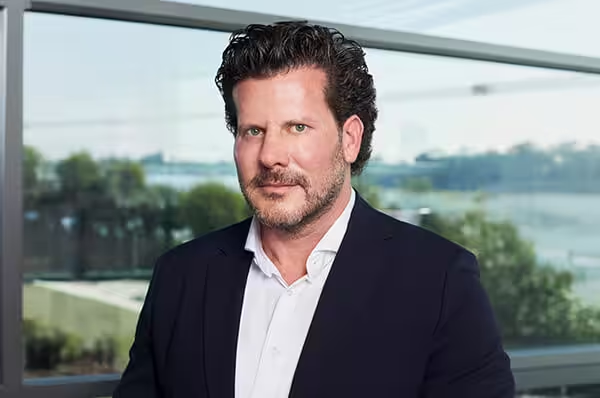
Michael Rainer
Rechtsanwalt, Founder & CEO

Marc Klaas
Rechtsanwalt, Partner

Michael Below
Rechtsanwalt, LL.M., Salary Partner



Berlin
Cologne
Hamburg
Düsseldorf
Frankfurt
Munich
Stuttgart
Leipzig
Local. Regional. International.
Insolvency Filing or Self-Administration: Which Path Fits in Crisis
Background and the Right Strategy for Clients
An insolvency filing carries both risks and opportunities. Self-administration allows companies to steer their course despite financial distress. Unlike regular insolvency, where an insolvency administrator takes control, operational management remains in the hands of the executives. The StaRUG (Stabilization and Restructuring Framework Act) opens up further options to respond early to crisis situations and potentially avoid an insolvency filing. Especially in a dynamic economic hub like Cologne, where many companies in media and FinTech are active, choosing the best restructuring strategy is essential.
The legal prerequisites for self-administration are clearly defined. Companies must demonstrate their ability to manage their restructuring independently. The obligation to file for insolvency under § 15a InsO must be particularly observed to avoid liability risks for management. StaRUG offers the possibility to achieve creditor approval through a restructuring plan without entering insolvency proceedings directly. These procedures require careful planning and comprehensive legal advice to optimally exploit opportunities and minimize risks.
For executives and shareholders, it is crucial to choose the right restructuring option early and be fully informed about the legal implications. Timely advice from the MTR Legal team can help secure the company's future and minimize personal liability risks. Creditors should also be informed about their rights and influence in restructuring procedures to protect their interests.
Director's Liability in Crisis: Duties and Action Options
Background and the Right Strategy for Clients
Director's liability in times of crisis is a critical issue. In periods of economic uncertainty, directors face the challenge of minimizing personal liability risks. The StaRUG process offers an opportunity to reconsider and shape the duties related to insolvency filing. Timely advice can help prevent liability risks and secure entrepreneurial action capability. In an environment like Cologne, where diverse industries such as media and insurance are located, understanding these legal mechanisms is highly relevant.
The Corporate Stabilization and Restructuring Act (StaRUG) opens new ways to handle crisis situations without directly filing for insolvency. §§ 1 to 3 StaRUG are crucial as they regulate the duties of management in crisis. A special role is played by self-administration, where management remains in control despite insolvency. This option can strengthen control over the company but also carries risks if legal requirements are not met. Non-compliance can lead to liability claims affecting directors personally.
For directors and shareholders, it is essential to evaluate action options early and choose the appropriate restructuring strategy. Sound legal advice can significantly contribute to reducing liability risks and putting the company on a stable course. The MTR Legal team is at your side with comprehensive experience to develop the best solutions for your individual situation.
Creditor Interests in Crisis: Legal Duties and Scope for Action
Background and the Right Strategy for Clients
Creditor interests often take center stage in a crisis. The right strategy to protect these interests is crucial for legal security and to strengthen creditor trust. The Corporate Stabilization and Restructuring Act (StaRUG) offers an opportunity for early restructuring, allowing for a restructuring process without filing for insolvency. Companies facing financial difficulties can take measures before insolvency becomes unavoidable. It is important for executives and shareholders to be well-versed in the legal framework to avoid potential personal liability risks while considering creditor interests.
Self-administration and protective shield procedures are additional restructuring options that leave companies with some control over the process. StaRUG allows for comprehensive restructuring measures with creditor approval without the need for an insolvency filing. This can be a valuable alternative to stabilize the company and satisfy creditors. It is important to communicate openly and transparently with creditors to gain their support. The legal framework of StaRUG requires precise planning and execution to meet legal requirements and minimize liability risks.
For executives, shareholders, and creditors in Cologne, it is advisable to seek legal advice early to identify suitable crisis management measures. Choosing the right procedure can determine whether a company is successfully restructured or not. A detailed analysis of the economic situation and close collaboration with experienced lawyers are essential to effectively protect creditor interests.
Frequently Asked Questions about Restructuring and the StaRUG Process
What You Should Know Before Consulting on Restructuring in Crisis (StaRUG)
What is the StaRUG process and how can it help?
The StaRUG process, short for Corporate Stabilization and Restructuring Act, offers companies in financial distress the opportunity to conduct restructuring outside of insolvency proceedings. The goal is to avert impending insolvency. The process allows for reaching an agreement with creditors based on a majority decision. This can involve both debt adjustments and restructuring of company management. It provides a flexible and less public alternative to regular insolvency.
When is there an obligation to file for insolvency?
An obligation to file for insolvency exists when a company is insolvent or over-indebted. Insolvency occurs when a company cannot meet its due payment obligations. Over-indebtedness means liabilities exceed assets unless the continuation of the company is predominantly likely. The insolvency filing must generally be made within three weeks of the occurrence of insolvency or over-indebtedness to avoid personal liability risks.
What advantages does self-administration offer compared to regular insolvency?
In self-administration, management remains in office throughout the process and retains control over the company. This can facilitate restructuring since management is familiar with operational processes. Additionally, the process is supervised by a custodian who protects creditors' interests. Self-administration thus offers the possibility of more efficient and flexible restructuring compared to regular insolvency, where an insolvency administrator usually takes control.
What personal liability risks exist for directors?
Directors can be held personally liable for breaches of duty. This includes, in particular, the failure to file for insolvency in a timely manner. Violations of accounting obligations or unauthorized payments after the onset of insolvency or over-indebtedness can also trigger liability claims. During restructuring, directors should act with particular care and comply with all legal requirements to minimize personal liability risks.
Protective Shield Procedure under § 270b InsO: Opportunities and Limitations
Background, Risks, and the Right Strategy
The protective shield procedure under § 270b InsO offers protection and structure. It allows companies in crisis to initiate restructuring under the supervision of a preliminary custodian. Executives and shareholders facing insolvency filing obligations can particularly benefit from this procedure. In Cologne, a major economic hub with a strong media and insurance sector, timing the application correctly is crucial. The procedure can be used to avert imminent insolvency and enable comprehensive restructuring. MTR Legal assists you in developing the right strategy and minimizing risks.
The protective shield procedure represents a form of "preliminary self-administration," allowing companies to implement restructuring measures under court supervision. Unlike regular insolvency, company management remains decision-making while a preliminary custodian oversees the management. It is crucial that the company is not yet insolvent and can present a restructuring concept. The legal framework under § 270b InsO requires precise planning and execution. MTR Legal is at your side to clarify legal prerequisites and successfully shape the restructuring.
For executives and shareholders, the protective shield procedure offers an opportunity not only to stabilize the company but also to reduce personal liability risks. Through our comprehensive advice and support, you can effectively utilize restructuring options and get your company back on track. Our lawyers in Cologne specialize in developing tailored solutions that meet the individual needs of your business.
Self-Administration: Prerequisites and Risks for Directors
Background, Risks, and the Right Strategy
Self-administration allows for entrepreneurial control despite insolvency. Our lawyers explain how self-administration helps you independently shape the restructuring. In Cologne's dynamic economic landscape, self-administration can be a valuable option, especially for directors and shareholders who wish to retain control over the restructuring process. The self-administration process offers the possibility to retain company leadership during the procedure while benefiting from the protective mechanisms of the insolvency code. This can be crucial in crisis situations to ensure business continuity and protect the interests of all parties involved.
Self-administration requires careful preparation and adherence to certain legal prerequisites to be successfully applied. For instance, a positive continuation forecast and a viable restructuring plan must be presented. The StaRUG process provides a legal basis to respond early to crisis situations and avoid insolvency. §§ 270a and 270b of the insolvency code regulate self-administration and provide a framework to minimize liability risks. Our lawyers at MTR Legal support you in understanding the legal requirements and taking the necessary steps for successful self-administration.
For directors and shareholders, understanding the legal and economic implications of self-administration is essential to make informed decisions. MTR Legal offers comprehensive advice to develop the best strategy and ensure effective implementation. In Cologne's corporate landscape, ranging from innovative start-ups to established corporations, our lawyers' experience is crucial to crafting individual solutions tailored to your company's specific needs.