

ESG Compliance – Sustainability Law & Supply Chain Due Diligence for Augsburg
Corporate Criminal Law
LkSG Compliance in Augsburg: Securely Meeting Supply Chain Obligations
Experienced ESG Compliance Advisory in Augsburg — Structured and Secure
In Augsburg, a significant hub for mechanical engineering and the digital economy, ESG compliance is of utmost importance. Companies in leading sectors such as special machinery manufacturing or the IT and digital economy must implement the requirements of the Supply Chain Act (LkSG) to secure their market position. Particularly for Augsburg-based family businesses in succession planning or growth phases, the obligation for risk analysis poses a significant challenge. Without careful implementation, sanctions of up to 2% of annual sales may threaten economic stability.
MTR Legal is the ideal partner in Augsburg to support you in implementing LkSG requirements. The firm combines solid legal knowledge with extensive client experience in relevant industries. Thanks to its interdisciplinary setup, MTR Legal can develop tailored solutions that meet the specific needs of Augsburg companies. Rely on MTR Legal’s experience to establish secure and structured compliance processes. Talk to our team in Augsburg to discuss your requirements and effectively manage risks.
- Steinerne Furt 72, 86167 Augsburg
- +49 821 89949040
- augsburg@mtrlegal.com
5000+
Mandate
Team
Experienced Attorneys
Global
International Presence
8
Offices
Competence that Convinces.
Utilize our expertise für Augsburg and book a consultation to address your concerns professionally.
ESG Compliance Advisory in Augsburg: Competent and Structured
Competent ESG Compliance Advisory from a Single Source
- Supply Chain Act: Who is Affected and What Needs to be Done
- Legal Requirements of the LkSG and the CSRD
- ESG Compliance in Augsburg: Legal Foundations
- How MTR Legal Builds Your LkSG Compliance
- Typical Compliance Gaps in the Supply Chain Act
- Step by Step to an LkSG-Compliant Organization
- Frequently Asked Questions About LkSG Compliance
- Risk Analysis under LkSG: What Needs to be Examined
- Handling Identified Risks in the Supply Chain
International Representation
As a member of the international network of lawyers IR Global, we are your point of contact for cross-border matters and represent you in an international context.
Supply Chain Act: Who is Affected and What Needs to be Done
What You Need to Know About the Supply Chain Act
The Supply Chain Act (LkSG) poses a significant challenge for companies in Augsburg and across Germany, particularly regarding extensive due diligence obligations. For compliance officers and executives in companies with over 1,000 employees, understanding and effectively implementing the requirements of this law is crucial. In Augsburg, as the economic center of Bavarian Swabia, companies in mechanical engineering and the digital economy are particularly affected. They must ensure their supply chains comply with legal requirements to minimize risks and avoid sanctions.
The LkSG requires companies to conduct thorough risk analysis throughout the entire supply chain. Failure to do so can lead to significant sanctions, up to 2% of annual sales. Compliance with § 3 LkSG, which details the risk analysis, is particularly important. Companies must implement mechanisms to identify and address human rights violations and environmental risks early on. MTR Legal supports you in understanding and implementing these legal requirements to strengthen your compliance strategy.
For clients, this means proactively taking measures to fulfill legal obligations and prevent potential sanctions. MTR Legal offers the legal advice and support you need to optimize your compliance processes and effectively manage supply chain risks. This allows you to focus on your core business while we ensure your legal obligations are met.
Legal Requirements of the LkSG and the CSRD
What the Law Prescribes — and What Clients Can Make of It
The implementation of due diligence obligations under the Supply Chain Act (LkSG) is crucial for Augsburg companies, especially in the traditionally strong mechanical engineering sector. For compliance officers and executives of larger companies with over 1,000 employees, compliance with the requirements is essential. Non-compliance can result in sanctions of up to 2% of annual sales, which can have significant financial impacts. Timely implementation of the LkSG requirements can not only minimize legal risks but also positively influence the company's reputation.
The Supply Chain Act requires companies to conduct comprehensive risk analyses to fulfill human rights and environmental due diligence obligations. Central provisions such as § 3 LkSG define the necessary measures for risk identification and prevention. Recent court rulings show that courts strictly interpret the requirements for documenting and implementing these measures. Companies must establish processes to identify and address supply chain risks early. These obligations also extend to indirect suppliers, requiring a comprehensive review of the entire supply chain. Developing specific compliance strategies offers flexibility to meet legal requirements while preserving business interests.
For Augsburg mechanical engineering companies, this means not only adjusting internal processes but also actively shaping relationships with suppliers. MTR Legal supports companies in developing tailored compliance programs that meet legal requirements and consider the company's specific needs. A proactive approach can help minimize financial risks while strengthening the company's market position.
ESG Compliance in Augsburg: Legal Foundations
Competent ESG Compliance Advisory from a Single Source
For companies in Augsburg, particularly in mechanical and special machinery manufacturing, implementing due diligence obligations under the Supply Chain Act (LkSG) is crucial. These requirements are not only essential for legal security but also for the sustainable orientation of the company. In Augsburg's growth-oriented digital economy, many companies face the challenge of efficiently and securely fulfilling new compliance obligations. The MTR Legal team offers competent advice tailored to the individual needs and structures of Augsburg companies. Our approach is always personal and structured, working closely with clients.
The requirements of the LkSG, such as the risk analysis obligation, present significant challenges for executives and compliance officers. Sanctions of up to 2% of annual sales for violations underscore the necessary adjustments in business processes. MTR Legal provides support in implementing these legal requirements by developing practical solutions tailored to the company's specific context. Our experience includes developing compliance strategies that identify and minimize risks early.
For Augsburg entrepreneurs, this means having a reliable partner in MTR Legal who translates the complex legal requirements of the LkSG into understandable and actionable measures. This enables companies to achieve their compliance goals while strengthening their market position. Our team is ready to work with you to develop sustainable and legally secure solutions.
Create Clarity – Now!
For legal clarity and strategic foresight – our team in Augsburg is ready to support you. Don’t hesitate to contact us.
Your Team
Competent. Assertive. Successful.
In Augsburg, our team provides advisory services that personally and structurally address your individual needs. We work closely with our clients to develop tailored solutions that meet the requirements of the Supply Chain Act. From working with MTR Legal, you can expect us to handle your concerns with the utmost care and a deep understanding of the legal challenges in your industry.
Our focus in LkSG compliance lies in supporting the implementation of due diligence obligations and conducting risk analyses. MTR Legal is the right partner because we have the knowledge and experience to guide companies safely through the legal requirements of the Supply Chain Act. Our experience helps you avoid sanctions and efficiently achieve your compliance goals. Contact us to ensure your company in Augsburg and beyond is legally well-positioned.
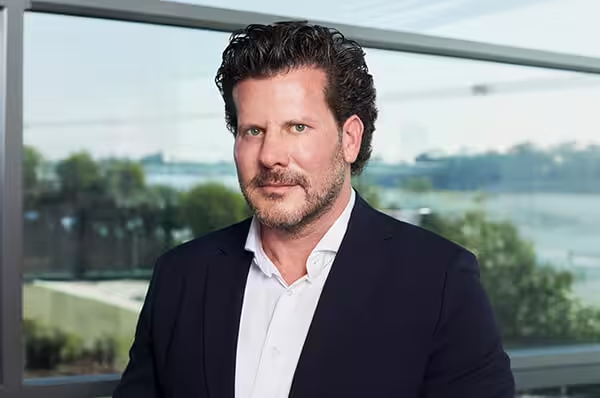
Michael Rainer
Rechtsanwalt, Founder & CEO
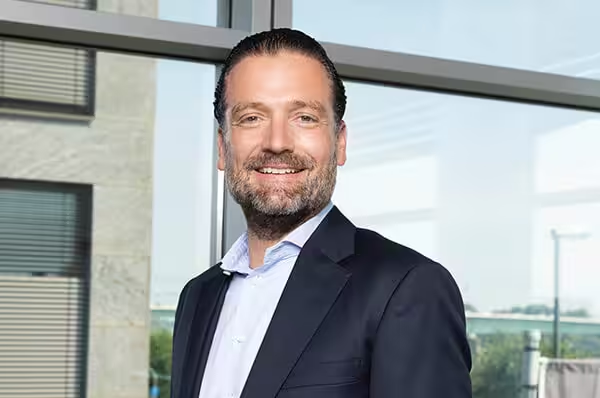
Marc Klaas
Rechtsanwalt, Partner

Michael Below
Rechtsanwalt, LL.M., Salary Partner




Berlin
Cologne
Hamburg
Düsseldorf
Frankfurt
Munich
Stuttgart
Leipzig
Local. National. International.
How MTR Legal Builds Your LkSG Compliance
Analysis, Strategy, and Implementation from a Single Source
The implementation of due diligence obligations under the Supply Chain Act (LkSG) is of significant importance for companies, especially those in Augsburg engaged in mechanical engineering. These obligations are not only legally required but also crucial to avoid potential financial sanctions of up to 2% of annual sales. For compliance officers and executives with over 1,000 employees, the challenge is to efficiently and sustainably integrate the new requirements. MTR Legal supports companies in integrating these complex requirements into their existing business structures to minimize risks.
The first step in MTR Legal's approach to ESG compliance mandates involves a comprehensive initial consultation and a detailed analysis of the company's situation. This includes examining the specific requirements of the Supply Chain Act and developing a tailored strategy. The goal is to fully meet the risk analysis obligation and identify potential weaknesses early. Strategy development considers the company's and industry's specific characteristics to offer tailored solutions. Practical consequences of this analysis are targeted implementation steps within a clearly defined timeframe. This ensures that compliance requirements are not only formally met but also practiced effectively.
For clients, this means they can rely on a structured and practical implementation of due diligence obligations. MTR Legal accompanies the entire process from planning to implementation to ensure all legal requirements of the LkSG are met. This allows companies to not only prevent legal risks but also strengthen their competitive position and enhance their reputation as responsible market participants.
Typical Compliance Gaps in the Supply Chain Act
What Can Go Wrong — and How Legal Advice Protects
The implementation of due diligence obligations under the Supply Chain Act (LkSG) is crucial for many companies, especially those in economically strong regions like Augsburg. The city is known for its mechanical engineering and growing digital economy, with many family businesses in growth or succession planning phases. For executives and compliance officers with over 1,000 employees, recognizing the risks of inadequate compliance is essential. Without legal advice, errors in risk analysis can occur, potentially leading to high sanctions of up to 2% of annual sales. This can significantly endanger the financial stability and reputation of the company.
A common problem in implementing LkSG requirements lies in inadequate risk analysis. This analysis is a central part of the law and requires a thorough assessment of all potential risks along the supply chain. Companies that make mistakes here risk violating due diligence obligations, which can lead to significant financial sanctions. The law stipulates that non-compliance with obligations can be penalized with fines of up to 2% of annual sales. Especially in mechanical engineering, the supply chain is often complex, increasing the requirements for a thorough risk analysis. Without proper legal support, these challenges are difficult to overcome.
What does this mean for you as a client? Compliance with LkSG requirements is not only a legal obligation but also a strategic advantage. Comprehensive legal advice from MTR Legal can help you effectively implement the requirements of the Supply Chain Act while minimizing potential risks. Our team supports you in conducting precise risk analyses and optimizing compliance processes to avoid sanctions and sustainably protect your company.
Step by Step to an LkSG-Compliant Organization
Which Steps to Take When and What Clients Should Prepare
For companies in Augsburg, particularly in the strongly represented mechanical engineering industry, implementing due diligence obligations under the Supply Chain Act (LkSG) is of significant importance. These requirements not only concern compliance with legal standards but also securing a good reputation and market position. The risk analysis obligation is a central point, as it forms the basis for all further compliance measures. Without a solid analysis, companies can face significant sanctions of up to 2% of annual sales. The time and resource investment for implementing these obligations can be substantial, making a structured approach essential.
The process of ESG compliance mandates begins with a comprehensive risk analysis. This step requires a detailed examination of the entire supply chain to identify potential risks. Subsequently, risk mitigation measures must be developed and implemented. According to § 4 LkSG, companies are required to regularly review and adjust these measures as needed. Creating and maintaining appropriate documentation is essential, as it forms the basis for internal and external evidence. The entire process can take several months, especially with complex international supply chains.
For compliance officers and executives, this necessitates timely planning and implementation. MTR Legal is your partner in efficiently organizing the fulfillment of due diligence obligations and avoiding legal pitfalls. Through close collaboration with our team, you can ensure all legal requirements are met and your company is optimally positioned to avoid sanctions.
Frequently Asked Questions About LkSG Compliance
What Clients Often Want to Know About ESG Compliance
What is the Supply Chain Act (LkSG) and who is affected by it?
The Supply Chain Act (LkSG) requires larger companies, typically with more than 1,000 employees, to observe due diligence obligations throughout the entire supply chain. The goal is to minimize human rights violations and environmental risks. Affected companies must conduct a risk analysis, implement preventive measures, and report on their activities. Compliance is monitored by the Federal Office for Economic Affairs and Export Control (BAFA), which can impose sanctions for violations. These sanctions can amount to up to 2% of annual sales.
When does my company need to conduct a risk analysis under the LkSG?
A risk analysis is a central element of the due diligence obligations under the LkSG and must be conducted regularly. Companies are required to identify and assess all potential risks in their supply chain. The analysis should be conducted at least annually or when significant changes occur in the supply chain or business environment. The results of the risk analysis form the basis for developing and adjusting preventive and remedial measures to effectively manage risks.
How is the implementation of due diligence obligations under the LkSG carried out?
The implementation of due diligence obligations begins with the establishment of a risk management system, followed by a comprehensive risk analysis. Based on the results, companies must implement preventive measures to minimize identified risks. It is also necessary to implement remedial measures for identified violations. This includes establishing a complaint mechanism and regularly reporting on the measures and their effectiveness. Compliance with these obligations is regularly reviewed and documented.
What costs can arise from implementing the LkSG?
The costs of implementing the LkSG vary depending on the company's size and the complexity of the supply chain. Typically, costs arise for setting up a risk management system, conducting risk analyses, and implementing preventive and remedial measures. Additionally, internal training and report preparation may be required. Possible sanctions for non-compliance with the law must also be considered. Early and comprehensive planning can help optimize costs.
Risk Analysis under LkSG: What Needs to be Examined
What You Need to Know About LkSG Risk Analysis
The LkSG risk analysis is crucial for companies to ensure compliance with due diligence obligations under the Supply Chain Act. For Augsburg companies, particularly in mechanical engineering and the digital economy, the risk analysis offers an opportunity to identify and address potential human rights and environmental violations in their supply chain early. Executives and compliance officers in Augsburg must not only conduct these analyses but also document them. This is essential to avoid sanctions that can amount to up to 2% of annual sales. The careful implementation of these requirements is a significant challenge but can also be seen as an opportunity to strengthen corporate responsibility and reputation management.
The methodology of risk analysis under the Supply Chain Act requires a systematic approach. Companies must identify and assess risks arising from direct and indirect business activities. Documentation plays a crucial role in ensuring transparency and traceability. The law requires companies to document all relevant data and measures to be prepared for an audit by authorities. The legal requirements are outlined in § 4 LkSG and include comprehensive reporting obligations. The practical consequence is that companies must establish an effective risk management system that includes both proactive and reactive measures.
For MTR Legal clients, this means receiving comprehensive support in implementing LkSG requirements. Our team advises on conducting and documenting the risk analysis and helps make these processes legally secure. In practice, this means developing tailored solutions that meet the individual requirements and structures of the company. This ensures that your company not only operates in compliance with the law but is also sustainably and responsibly positioned.
Need Legal Assistance?
MTR Legal Augsburg offers professional legal advice. Let’s find the best solution together.
Handling Identified Risks in the Supply Chain
What Clients Need to Know About Handling Identified Risks in the Supply Chain
For companies in Augsburg, particularly in mechanical engineering, handling identified risks in the supply chain is crucial. Compliance with due diligence obligations under the Supply Chain Act (LkSG) is increasingly becoming an economic necessity. Companies must ensure they not only meet legal requirements but also protect their reputation and market position. Risks in the supply chain can range from human rights violations to environmental damage. Compliance officers and executives of companies with over 1,000 employees face the challenge of systematically analyzing and mitigating these risks.
As part of ESG compliance, risk analysis under the Supply Chain Act is a key step. According to § 3 LkSG, companies are required to conduct a risk analysis that identifies potential and actual adverse impacts on human rights and the environment. This analysis forms the basis for all further measures. Companies that fail to meet this obligation risk sanctions of up to 2% of their annual sales. Practically, this means companies must implement processes to continuously evaluate and address risks. Practice shows that a close integration of legal and operational measures is necessary to efficiently meet the requirements.
For clients, this means they must act proactively and take timely measures. MTR Legal supports companies in structuring the risk analysis and implementing necessary compliance measures. Our team offers comprehensive advice to ensure all legal requirements are met. This enables companies not only to avoid sanctions but also to strengthen their competitiveness and build sustainable business relationships.